Showing posts with label Aleister Crowley. Show all posts

'Darren Storer Reading' at Русский мир, 18th July 2014


"This is David.  He's a journalist.  He's going to write about us".  A roomful of eyes turned to me as I sheepishly waved hello.  The speaker was David William Parry, Heathen Priest of the Goddess Nerthus, poet, critic, dramaturge, academic - kind of a big cheese in the Pagan community.  Ruddy-faced and tweed-clad he fixed me with an authoritative stare that unmistakably read "don't write anything nasty, or else".

I began to wonder just what the hell I'd signed up for.  Underneath a sex shop on Goodge Street lies Русский мир, a book shop, restaurant and repository for all things Russian. Inside are a motley gathering of Britain's heathens, heretics and pagans; collectively gathered under the umbrella of 'Theo-Humanist Arts'.  They describe themselves as "promoting the cause of radical religious Arts across the globe.  We celebrate our shared humanity, while aiming to grasp spiritual truth".


Sounds reasonable enough.  The centre of the night was poet Darren Storer, reading from his new book The Recusant Who Never Recanted, an epic collection of poetry that probes the author's beliefs and the hypocritical society that surrounds him.  Storer is an incredibly interesting man; a self described powerful psychic prone to dramatic visions and who frequently lapses into trance states while writing, emerging to find pages of text he has no memory of writing.  In appropriately reverent tones he explains that he could be channelling Edgar Allen Poe, or even The Great Beast himself, Aleister Crowley.

Storer's poetry seeks to make followers of those that experience it, joining him in an epic voyage through a world populated by those antagonistic to him, whose reactions range from incomprehension to aggression.  He bats questions away from Christians who interrogate him as to whether he's a Satanist, "I have older friends" he archly replies.  As he recites he leans on a cane, grimacing every few lines as he worked his way through a fat bushel of papers.  

Darren Storer
At about 40 minutes long this is a one hell of a reading, often feeling as if he's guiding us down the rabbit hole.  There's the odd overly forced rhyme and a blizzard of purple prose, but it all hangs together.  As Storer spins out his poem it occurs to me that the very act of reading it might be some form of magickal incantation in and of itself. I glance over his wife's Sarah Tiger's paintings hung on the wall next to me - clawed hands reaching through sigils and spiralling pentagrams.  

My life keeps intersecting with the occult in all sorts of weird ways.  Last year, just after having been invited by the Warberg Institute to examine his personal papers I literally stumbled across the Crowleyian history book Sword of Wisdom by Ithell Colquhoun, which someone had, for some reason, left lying on a Notting Hill pavement.  Just a couple of days ago I was enjoyably picking my way through the Comics Unmasked: Art and Anarchy in the UK exhibition in the British Library. I turn a corner and find the staring eyes and hairless pate of Crowley bearing down on me, hearing an audio recording of the man himself tinnily chanting down through the years.

Sarah Tiger and one of her paintings.
I don't buy into the mysterious forces that Crowley claimed to have grasped, but I do respect the man for leading one of the most interesting lives I've ever read about.  I'm also fascinated with the history of Occult Britain, which I like to read as a mutant reflection of very British preoccupations for ceremony, tradition and class.  But it's one thing to sit around writing about this.  It's quite another to be sat in a small, hot room full of people that really sincerely believe.

Looking around I wonder who these people are, what they do and where they go at night. Chatting outside later I learn that they consider themselves a family - members are husbands and wives, godfathers to each other's children and so on.  To be honest the word 'family' in this context makes Charlie Manson (that other famous beast of the 20th Century) spring unbidden to mind.  I feel guilty making the association, especially as everyone here appears nice and polite enough.  That said, I still felt a little bit like Edward Woodward in The Wicker Man.

Adding to my nerviness is knowing the unfortunate tendency of some strands of Paganism to trip over into far right views.  Hanging out with Satanist Nazis is the last thing I want to do on a sunny Friday evening, so I find myself desperately hoping that I don't spot any old NF tattooes in this pleasantly diabolical crowd.  Thankfully everything feels relatively apolitical - perhaps I've just read a bit too much about the vagaries of Norwegian Black Metal and their predilection for Norse mythology.

I love discovering what's going on in the hidden places of London, sniffing out interesting subcultures and meeting the kinds of people you only hear faint whispers of.  In that regard I had a hell of an interesting time - though not knowing anything about theo-humanism or this particular brand of Paganism left me afloat in a deep, murky, unfamiliar sea.  As I cycled home my head spun trying to think of some way to conclude my thoughts on the night.  Then I stopped off at a supermarket to buy some dinner.  


Oh shiiiiiiiit!

'Occult Atlas: Aleister Crowley' at the Warburg Institute, 2nd September 2013

7:34 AM Posted by londoncitynights , , , , , 4 comments

Last week, after narrowly escaping a burning art gallery, I was strolling back through the gloomy, underlit streets of Notting Hill when my foot struck something on the pavement. It was a book, skidding along the stones in front of me.  I stopped, bent down and plucked it from the pavement: Sword of Wisdom: MacGregor Mathers and the Golden Dawn.  The book, a history of the magical Hermetic Order of the Golden Dawn constantly mentions Aleister Crowley; aka Frater Perdurabo; aka 'The Great Beast 666'; aka Baphomet; aka The Mad Mullah; aka Oliver Haddo; aka "The Wickedest Man in the World". Aleister Crowley, the most notorious occultist of all time - the man whose papers I had just booked a place to view the following Monday.

The coincidence was unsettling - it's a bit portentous to literally stumble across a guide to British occultism just as I'm about to nose my way through Crowley's personal artefacts.  I don't believe there's any dark forces influencing my life, but despite my rationalism I couldn't help the chill that ran down my spine.  The source of that chill died sixty-five years ago, penniless and addicted to morphine, in a Hastings boarding house: his last words reported as "I am perplexed".  Yet Crowley's gravitational pull only increases as the years tick by, the mists of time obscuring his fleshy, all-too-human foibles, creating a mysterious, sinister figure that menacingly glares at us across the decades.

The Warburg Institute, nestled in a leafy square on the University of London's Bloomsbury campus, is devoted to academic investigations of the influence classical antiquity on Western civilisation.  As you walk through the doors the bricks practically ooze with knowledge, such is weight of learning within these walls.  We're led into a small classroom, and given a potted history of the place.  On the blackboard behind our host is a diagram that reads "Egyptians > Kabbalah > ??? > Jesus > Early Church Fathers > Spinoza".  I love these little peeks into what's going on inside these institutions; there's something impossibly romantic about people exploring exotic gnosticism while commuters rumble past on the number 24 bus.


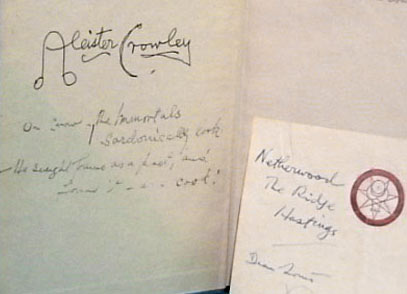
As interesting as the history of this place is, all eyes are on a thick burgundy book resting on the table, the pages a sickly yellow.  This is what we've come here to leaf through; Gerald Yorke's collection of Aleister Crowley's papers; consisting of hundreds of pieces of Crowley esoterica: iconic photos, architectural sketches, letterheads, wax seals, detailed correspondence, paintings and his business cards.  This is the flotsam and jetsam of a life, a gallery of potent direct physical connections to the past.

There's a fetishistic thrill in interacting with original documents, a sensuous enjoyment in running your fingers across the slight indentations the Crowley's pen carved into the paper, or feeling soft pencil scribbles making up diagrams, feeling as though a sneeze might blow it all away. Just the knowledge that this actual piece of paper was in Crowley's hands creates a frisson of electricity.  Turning the pages of this collection is an archaeological dig: encompassing not only the expected evidence of scandal, mysticism and kinky sex but a peek behind the curtain at mundanity - half-baked ideas and sweetly amateurish sketches.

Crowley in the robes of the Golden Dawn
There's a quaint 'Hammer Horror' feel to these sketches and photographs; a sense of a very English magic - serious looking ex-public schoolboys parading around in extravagant robes in rather mundane looking surroundings.   Leafing through these documents you begin to piece together a careful system of occult bureaucracy - application letters from prospective members, neatly typed letterheads, business cards and polite, reserved correspondence between members, entirely ordinary except for the fact that they're talking about the oncoming Æon of Horus, humanity's time of self-actualisation and the triumph of individuality and 'True Will'.

The members of these societies are often famous in their own right, a tangled web winding its way through the upper crust of London's artistic community.  Deciphering these complex relationships and various societies is tricky, but fortunately we had Gary Lachman in attendance; an expert on mysticism and the occult (and founding member and bassist in Blondie!).  He puts flesh on the bones these document's bones, guiding us through the winding labyrinth of Crowley's complicated life.

Gary Lachman talking the talk.
This was invaluable in understanding these documents.  For example, we came to a birth/death certificate for Crowley's young daughter Lilith.  In isolation this is a faintly sad, clinical document, but just a cold collection of facts.  Gary tells us a story: Crowley and his then-wife Rose were on a visit to India.  When they were due to leave (after Crowley had shot a guy), he convinced his wife that they should travel separately and that she should take his daughter with her.  His reason for travelling alone was that we wanted to sleep with a fellow occultist.  On returning to Britain he discovered that his child had died of typhoid on the journey.  Griefstricken, he blamed his wife for the death, accusing her of being too drunk to sanitise the baby's bottle. Gary archly points out that the notion that Crowley could have accompanied them doesn't appear to have crossed his mind.

These recognisably human reactions define the man as much as this collection of documents. The pictures are enlivened by tales tales of how Crowley and his friends used to hold wild parties at night in the Horniman Museum during which they'd remove the mummies from their sarcophagi and attempt to raise them from the dead. Or explaining that a reference in a letter to a mysterious Black Temple refers to 67 Chancery Lane - somewhere Crowley holed up, again trying to resurrect the dead.


Some of this stuff is bizarre even for this collection.  My favourite bit of oddness was the carefully conceived 'Crowley Grill', consisting of devilled kidneys, Cambridgeshire sausages, kidneys, anchovies, eggs, truffles, caviar on toast and devils on horseback (prunes wrapped in bacon).  He also came up with a lawn game based on his religion; 'Thelema Ball' and a board game.  These things shine a light on Crowley as shameless self-publicist, the kind of man that takes a quiet glee in faking his own death and reappearing dramatically a few months later, a man who obviously adored his status as "The Wickedest Man in the World" .

The visit dispelled my image of Aleister Crowley as a sinister man of mystery. Though it more than supports his deserved reputation as a fascinatingly radical libertine, it also shows him up as a shameless self-publicist with a juvenile sense of humour (check out his signature).  Gary's useful filling in of the blanks also paints a picture of frankly, a bit of an arsehole, Crowley attracting women on the verge of mental illness, using them in intense rituals and pushing them over the edge into asylums.  But arsehole he may have been, at least he was an interesting arsehole.

I'm pretty sure Crowley was never in touch with any mystical entities.  But that doesn't really matter.  Convincingly behave like you're in possession of diabolical powers and secret occult knowledge for long enough and people will begin to treat you as if you do - by that point you may as well actually have magical powers.  Crowley created his own personal mythology and lived it so vigorously that fiction and fact became blurred together - a process these documents chronicle in minute detail.   Though they humanise him the collection underlines Crowley's uniqueness - a life lived without compromise, full of controversy, kinky sex, dirty humour and a above all, a rapacious thirst for knowledge.

Thanks to the Curious Congress for arranging this, the Warburg Institute for hosting and to Gary Lachman for the much needed context.