Showing posts with label magic. Show all posts

'The Dance of Reality' (2013) directed by Alejandro Jodorowsky


Alejandro Jodorowsky is one of the most fascinating cultural figures of the last hundred years.  Equal measures director, actor, artist, philosopher, author and magician he's produced works of genius across a many media, developed his own religion and travelled the globe giving giving philosophical lectures on his philosophy. Like most people I became a fan through his films; the first time I saw The Holy Mountain knocked the stuffing out of me, instantly becoming my favourite film of all time.

Rabid for more I hunted down everything I could find that he'd touched (though I never got my hands on his poorly received 1980 film Tusk).  Once I'd exhausted his cinematic works I moved onto his writings.  As the years passed I resigned myself to never seeing a new film from him, you'd hear odd whisper about phantom projects like Son of El Topo or King Shot, but the financing always fell though and the hype amounted to nothing.

But here we are.  After 23 years a new Jodorowsky film: The Dance of Reality. Virgin mental soil to be ploughed. Has the master lost his touch? What fantastic images lie within?   Can this possibly live up to expectations?  Five minutes in a feminine, blue clad boy had killed every sardine in the ocean.  Later I would see a busty opera singer urinate on her plague-stricken husband.  Soon after there'd be a dog dressed as a kangaroo, graphic genital torture and a man inflicting brutal psychic kung-fu on parading Nazis.  He's BACK, baby!


All of Jodorowsky's major films are autobiographical to some extent, though previously confined to his philosophical and symbological development.  The Dance of Reality, adapted from his own autobiography, skews closer to history than any of his previous films in depicting Jodorowsky's actual childhood.  Shot through with a procession of indelible imagery, the film is a perfect realisation of the director's philosophy that "reality is not objective but rather a “dance” created by our own imaginations."

Born to Jewish-Ukrainian parents in the Chilean city of Tocopilla, Jodorowsky puts his younger self and father Jaime (played by his son, Brontis Jodorowsky) through a series of allegorical trials.  Childhood is presented as a world of strict binary divisions; the young Alejandro forced to choose between masculine and feminine, faith and atheism, fascism and communism, charity and selfishness and so on.  

Jodorowsky paints his upbringing in broad, traumatic strokes.  Most notably his mother and father physical manifestations of their traditional gender roles.  His mother (who only communicates through opera) is caring, artistic, soft, healing and erotic, while his father is uniformed, angry, disciplined and physically strong.  This will change.


One of Jodorowsky's trademark philosophical flourishes is the disintegration of boundaries. These can be physical, historical, ideological or psychological, but by the end of the film the walls are comin' down.  There's a but of beautifully straightforward philosophy early on when Alejandro encounters the 'Theosophist' (played by Cristobal Jodorowsky, the director's son).  He hands Alejandro three medals, the Christian cross, the Jewish star of David and the star and crescent of Islam, saying "They think they're separate, but melt them down in an oven and they will turn into a single drop."

Alejandro's father undergoes this process, going into the oven a hard-nosed ideologue and coming out as some kind of ruined saint unwilling to accept enlightenment.  Late in the film, with wild and hair and thick beard, Brontis Jodorowsky begins to bear an eerie resemblance to the younger Jodorowsky we know from El Topo and The Holy Mountain. A hall of mirrors effect quickly develops among the three central characters: the director as a boy, the director's father (also a symbol of Jodorowsky himself) and the director himself as ghostly presence.

This tangle is a cinematic realisation of Jodorowsky's self-devised psychomagic therapy. The method works as an exploration of the unconscious mind and to relieve repressed trauma. This trauma can be accumulated over the course of a lifetime and unconsciously passed through generations.  This dovetails with his theory of the unconscious as "over-self", and the collective weight of history pressing down upon individuals.  A human being thus becomes like a flower pressed in the pages of a book, locked in place with invisible psychological pressures acting on them from all sides.  


The key to relieving that pressure is the transmutation of psychology, history and compulsion into imaginative, artistic acts.  So, The Dance of Reality is a performance; the creation of the film a psychomagical exorcism of the director and a nudging of his audience towards an artistic reimagining of their own lives.

Still with me?  That all sounds a bit high-falutin I know, but Jodorowsky's work invites this kind of analysis. Anyway, even if you're not on board with esoteric mysticism this is still an incredibly beautiful and imaginative piece of cinema.  Jodorowsky scatters indelible images through his films like confetti, occupying a unique territory somewhere between the circus and the psychologist's sofa. It's nearly always surreal (and often disturbing), but it's a rarely sincere brand of surreal, images chosen because of their precise meaning rather than for shock value.

At 84 Jodorowsky shows no signs of slowing down, though this could very well be his last film.  It would be one hell of a cinematic swansong if it were, the elderly artist reflecting on his distant, dreamlike childhood and turning that fertile clay into art.  The film ends with the young Alejandro purposely marching through a sea of photographs of those left in the past; the ghosts of memory.  We cut a boat, and the director protectively embracing his younger self.  The captain is Death, and Jodorowsky slips away across the white void of a Styx, reciting his own eulogy:
"I soar away from the past, land in the body present, bear the painful burden of years, yet in the heart keep the child. As the bread of life. As a white canary. As a worthy diamond. As a lucidity without walls. Wide open doors and windows through which blows the wind. Only the wind. Just the wind."

★★★★★

The Dance of Reality is available on VOD now.

'Occult Atlas: Aleister Crowley' at the Warburg Institute, 2nd September 2013

7:34 AM Posted by londoncitynights , , , , , 4 comments

Last week, after narrowly escaping a burning art gallery, I was strolling back through the gloomy, underlit streets of Notting Hill when my foot struck something on the pavement. It was a book, skidding along the stones in front of me.  I stopped, bent down and plucked it from the pavement: Sword of Wisdom: MacGregor Mathers and the Golden Dawn.  The book, a history of the magical Hermetic Order of the Golden Dawn constantly mentions Aleister Crowley; aka Frater Perdurabo; aka 'The Great Beast 666'; aka Baphomet; aka The Mad Mullah; aka Oliver Haddo; aka "The Wickedest Man in the World". Aleister Crowley, the most notorious occultist of all time - the man whose papers I had just booked a place to view the following Monday.

The coincidence was unsettling - it's a bit portentous to literally stumble across a guide to British occultism just as I'm about to nose my way through Crowley's personal artefacts.  I don't believe there's any dark forces influencing my life, but despite my rationalism I couldn't help the chill that ran down my spine.  The source of that chill died sixty-five years ago, penniless and addicted to morphine, in a Hastings boarding house: his last words reported as "I am perplexed".  Yet Crowley's gravitational pull only increases as the years tick by, the mists of time obscuring his fleshy, all-too-human foibles, creating a mysterious, sinister figure that menacingly glares at us across the decades.

The Warburg Institute, nestled in a leafy square on the University of London's Bloomsbury campus, is devoted to academic investigations of the influence classical antiquity on Western civilisation.  As you walk through the doors the bricks practically ooze with knowledge, such is weight of learning within these walls.  We're led into a small classroom, and given a potted history of the place.  On the blackboard behind our host is a diagram that reads "Egyptians > Kabbalah > ??? > Jesus > Early Church Fathers > Spinoza".  I love these little peeks into what's going on inside these institutions; there's something impossibly romantic about people exploring exotic gnosticism while commuters rumble past on the number 24 bus.


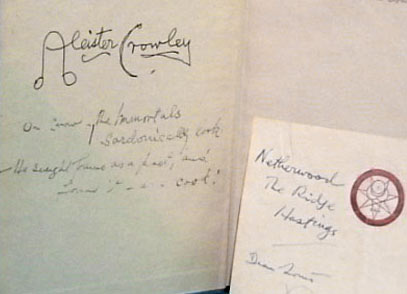
As interesting as the history of this place is, all eyes are on a thick burgundy book resting on the table, the pages a sickly yellow.  This is what we've come here to leaf through; Gerald Yorke's collection of Aleister Crowley's papers; consisting of hundreds of pieces of Crowley esoterica: iconic photos, architectural sketches, letterheads, wax seals, detailed correspondence, paintings and his business cards.  This is the flotsam and jetsam of a life, a gallery of potent direct physical connections to the past.

There's a fetishistic thrill in interacting with original documents, a sensuous enjoyment in running your fingers across the slight indentations the Crowley's pen carved into the paper, or feeling soft pencil scribbles making up diagrams, feeling as though a sneeze might blow it all away. Just the knowledge that this actual piece of paper was in Crowley's hands creates a frisson of electricity.  Turning the pages of this collection is an archaeological dig: encompassing not only the expected evidence of scandal, mysticism and kinky sex but a peek behind the curtain at mundanity - half-baked ideas and sweetly amateurish sketches.

Crowley in the robes of the Golden Dawn
There's a quaint 'Hammer Horror' feel to these sketches and photographs; a sense of a very English magic - serious looking ex-public schoolboys parading around in extravagant robes in rather mundane looking surroundings.   Leafing through these documents you begin to piece together a careful system of occult bureaucracy - application letters from prospective members, neatly typed letterheads, business cards and polite, reserved correspondence between members, entirely ordinary except for the fact that they're talking about the oncoming Æon of Horus, humanity's time of self-actualisation and the triumph of individuality and 'True Will'.

The members of these societies are often famous in their own right, a tangled web winding its way through the upper crust of London's artistic community.  Deciphering these complex relationships and various societies is tricky, but fortunately we had Gary Lachman in attendance; an expert on mysticism and the occult (and founding member and bassist in Blondie!).  He puts flesh on the bones these document's bones, guiding us through the winding labyrinth of Crowley's complicated life.

Gary Lachman talking the talk.
This was invaluable in understanding these documents.  For example, we came to a birth/death certificate for Crowley's young daughter Lilith.  In isolation this is a faintly sad, clinical document, but just a cold collection of facts.  Gary tells us a story: Crowley and his then-wife Rose were on a visit to India.  When they were due to leave (after Crowley had shot a guy), he convinced his wife that they should travel separately and that she should take his daughter with her.  His reason for travelling alone was that we wanted to sleep with a fellow occultist.  On returning to Britain he discovered that his child had died of typhoid on the journey.  Griefstricken, he blamed his wife for the death, accusing her of being too drunk to sanitise the baby's bottle. Gary archly points out that the notion that Crowley could have accompanied them doesn't appear to have crossed his mind.

These recognisably human reactions define the man as much as this collection of documents. The pictures are enlivened by tales tales of how Crowley and his friends used to hold wild parties at night in the Horniman Museum during which they'd remove the mummies from their sarcophagi and attempt to raise them from the dead. Or explaining that a reference in a letter to a mysterious Black Temple refers to 67 Chancery Lane - somewhere Crowley holed up, again trying to resurrect the dead.


Some of this stuff is bizarre even for this collection.  My favourite bit of oddness was the carefully conceived 'Crowley Grill', consisting of devilled kidneys, Cambridgeshire sausages, kidneys, anchovies, eggs, truffles, caviar on toast and devils on horseback (prunes wrapped in bacon).  He also came up with a lawn game based on his religion; 'Thelema Ball' and a board game.  These things shine a light on Crowley as shameless self-publicist, the kind of man that takes a quiet glee in faking his own death and reappearing dramatically a few months later, a man who obviously adored his status as "The Wickedest Man in the World" .

The visit dispelled my image of Aleister Crowley as a sinister man of mystery. Though it more than supports his deserved reputation as a fascinatingly radical libertine, it also shows him up as a shameless self-publicist with a juvenile sense of humour (check out his signature).  Gary's useful filling in of the blanks also paints a picture of frankly, a bit of an arsehole, Crowley attracting women on the verge of mental illness, using them in intense rituals and pushing them over the edge into asylums.  But arsehole he may have been, at least he was an interesting arsehole.

I'm pretty sure Crowley was never in touch with any mystical entities.  But that doesn't really matter.  Convincingly behave like you're in possession of diabolical powers and secret occult knowledge for long enough and people will begin to treat you as if you do - by that point you may as well actually have magical powers.  Crowley created his own personal mythology and lived it so vigorously that fiction and fact became blurred together - a process these documents chronicle in minute detail.   Though they humanise him the collection underlines Crowley's uniqueness - a life lived without compromise, full of controversy, kinky sex, dirty humour and a above all, a rapacious thirst for knowledge.

Thanks to the Curious Congress for arranging this, the Warburg Institute for hosting and to Gary Lachman for the much needed context.

'A Field in England' (2013) directed by Ben Wheatley


*spoilers within*

A Field in England is a testament to what you can do with a couple of costumes, some great actors and an eye for cinematography.  It's also a lesson on how little you really need to make a movie - get a couple of DV cameras, head out to a field and just starting shooting. There's a ton of limitations to shooting on a micro-budget like this and Wheatley demonstrates how to cleverly work around them - showing how to suggest with mood, dialogue and old fashioned cinematic sleight of hand what you don't have the money to put on screen.  

All of this is important, because A Field in England is one weird as hell film with, to put it mildly, questionable commercial potential.  Yet it's a film that raises interesting questions,: allowing Wheatley to continue his interrogation of the relationship between modern Britain and our violent, oppressive and chaotic history.


Whitehead (Reece Shearsmith)
We begin the film tumbling through a hedge in the middle of the Civil War. A battle rages on the other side of it, and running in terror away from both the carnage and his strict master is the effete, servile Whitehead (Reece Shearsmith).  He soon meets Friend (Ryan Pope) and Jacob (Peter Ferdinando), two working class travellers being held hostage by Cutler (Ryan Pope).  Whitehead joins the two men as Cutler's captive, who brings them to his master, O'Neill (Michael Smiley).  O'Neill is a Satanic, mystical and terrifying figure, and with Cutler as his stooge, forces the three captives to find the treasure he is convinced is buried in the field.

It's a pretty straightforward plot, but Wheatley makes a beeline for tripped out psychedelia and very quickly things become bizarrely tangled up.  The conscious decision here is to make a historical 'anti-epic'.  Period dramas are notorious for pumped-up self-importance: actors flouncing about in codpieces in astoundingly lavish sets before skipping off to CG-tinged, flashily shot battle sequences populated by thousands of jobbing extras.  Not here. This is a film that wallows in mud, shit, blood and disease.  In one excellent bit of dialogue, Whitehead diagnoses the many ailments of Jacob.  As he stares at his sore-covered cock he lists them off:
"You suffer a disease of the private parts occasioned by too much venereal sport.  I also deduce gout, a bloody flux, a pustule of the mouth, 'the pissing disease', St Anthony's Fire, haemorrhoids and palsy, brought on by drink."
Wheatley plays the sadist, taking an obvious pleasure in the misery he inflicts upon the men. His characters get stung when they shit in nettle patches, eat disgusting looking food and while digging a hole, get literally pissed on from above.  But though the film is frequently wryly humourous - the squalor and death gets to you, creating an oppressively stygian atmosphere. This black and white world echoes films like Tarkovsky's Andrei Rublev and Frantisek Vlácek's Marketa Lazarová.  There are several dreamy frozen tableaux that bring to mind medieval woodcuts in their composition, and one impossibly creepy moment where a grinning, apparently zombified Whitehead 'sniffs out' the buried treasure.  These scenes are  elevated by an excellent and hugely ominous ambient score by composer Jim Williams.


Intelligently, the script takes pains to make these characters archetypically British, their sensibilities immediately recognisable to a modern audience.  They grouse, whinge and moan, swearing all the while and make sarcastic comments about their predicament.  There's a tendency in cinema to treat historical characters as if they're in a Shakespeare play, but these men could walk into a pub anywhere in the country and start chatting away to the landlord and no-one would bat an eyelid.  But this isn't the only way Wheatley draws us into this world.

A major factor in this is the setting.  The rolling, grassy, tree-bordered field is a perfect 17th century surrounding and the period costumes fitting into it perfectly.  This works both ways though - the fact that you don't need to dress the set to make it look like the past means that it's severed in time.  We can imagine ourselves in this field - heck, we could hop on a train and physically be there in about half an hour - it's easy to picture walking where they are walking, standing there gazing out over a view essentially unchanged for thousands of years.  The constancy of these meadows weighs heavily in the British psyche, bringing to mind these famous lines from William Blake's Jerusalem:
And did those feet in ancient time.

Walk upon England's mountains green:
And was the holy Lamb of God,
On England's pleasant pastures seen?

This notion of continuity in the collective British cultural memory ties directly into the use of hallucinogens in the film: psilocybin mushrooms have been growing naturally on the British Isles since before there were people around to eat them.  They're as intrinsic a part of the British landscape as gorse, thistles, heather and nettles.  Every civilisation that has lived on this land here has had potential access to them.  If you or I go out to a sunny field and gobble a few handfuls, you'll experience the same intense sensory overload as a bored, thrill-seeking Celtic milkmaid.  You'll freak out like a Roman Legionnaire who happened to pick the wrong kind of mushroom for dinner.   You'll get a direct taste of the same rush of spiritual ecstasy that fuelled a Druidic priest as he stared up at the constellations on a summer's night.


The idea of a direct connection from modern Britain to the chaos of the past is something Wheatley explored in his last film, Sightseers (and, apparently in Kill List, which I really should watch ASAP).  In Sightseers a buttoned down 'nice' couple awoke the brutal warrior and homicidal witch buried within them, moving between ancient monuments, being haunted by the bloody pagan past of Britain.

With these connections painstakingly set up, what do we make of the bonkers, screeching, psychedelic apocalypse that makes up the film's conclusion?  This is the centrepiece of the film, a headlong launch into the avant-garde that's so intense that the film opens with a warning to audiences that some flashing, stroboscopic craziness is going to go down.  It's a pretty good simulation of an intense mushroom trip, but one image becomes repeated over and over - a rising black sun.

This is the Sol Niger, a powerful alchemical symbol that represents great transformative power.  It's entirely appropriate that it should turn up considering that Whitehead, who is experiencing this mushroom-powered shift in consciousness, is a alchemist by trade.  The Black Sun is heavily associated with a forced split in the Self, the chasm between the unconscious and conscious mind.  As as symbol, the Black Sun shatters logic and exploits cracks in our psychological armour - forcing a new level of understanding upon us.  This image is repeated in a number of forms throughout the film.


While it's O'Neill who's searching for literal buried treasure in the field, it's Whitehead, by ingesting the hallucinogens that discovers the source of true power within himself.  He's a character that's harnessed the psychogeographical power of the field, reversing the narrative flow of the film and effortlessly vanquishing the wounded O'Neill.  He defeats this devil by shooting his face off (a vision of which can be seen in twisted, mirrored form throughout the freakout sequence) and claiming his identity for his own.   Wheatley is saying, as he did in Sightseers, that the potential for cruelty and violence lies submerged inches from the surface the English psyche.  We may consider ourselves civilised, enlightened, cosmopolitan intellectuals, but we stand on the shoulders of monsters: slave traders, colonial torturers, atrocity-loving soldiers, blue-flecked barbarians - an army of horrors - our green and pleasant fields are fertilised with blood.

There's so much going on in A Field in England that it's difficult to summarise.  I haven't even touched on the thematic importance of the class divides running through the film.  This film is pretty damn far from the mainsteam, but it greatly rewards those willing to delve deep into its symbology.  I've seen it twice now, and a third time can't be long coming.

★★★★

A Field in England is out on practically every format right now.

'House of Burlesque’ at London Wonderground – 23rd May 2012


Burlesque is a tricky one.  On one hand I like the retro aesthetics, the playfulness, the subversion and satire.  On the other hand, for all that is trumpeted about female empowerment it is still women taking their clothes off in front of a whooping crowd.

The London Wonderground is part of the ‘Udderbelly’ temporary area near the London Eye on the South Bank.  It’s quite nice down there, at least on a Wednesday night anyway (I suspect it might be a bit more crowded on a Friday).  The Wonderland area is decked out in wood in a sort of Americana themed way.  Customers can sit in model dodgem cars, sipping their drinks from plastic cups surrounded by cheesecakey retro 50s pinup pictures.   The stage area seems to be a cross between a circus tent and an old Western saloon.  For a temporary setup it’s pretty impressive, although on a night like this, hot, sticky and humid.  But, if you’re going to sit around watching girls dance about with very little on it seems strangely appropriate for it to be all steamy and hot under the collar.

I’ve been to a few burlesque shows before, but this was probably the most professional and elaborate.  Of the two I’ve seen before, one took place in a working men’s club, and the other in a burlesque club called 'Volupte' in the City.  This was more of a corporate, slick affair.  This company, “the House of Burlesque” has toured the world, and won prizes at the Edinburgh Festival.  Its members have performed with burlesque legend Dita von Teese.  It is, as far as burlesque companies go, one of the big fish.

The individual performances were pretty varied.  There was the expected 20s/30s style retro feather waving stripteases, but there were also circus acts involving ten hulahoops spun at once, a woman acrobatically swinging out over the audience, there were comedy numbers – a sort of quasi-mime strip, and a magic act.  There is no denying that these women are talented.  All of them were enjoyable to watch, and in all of the performances the personality (or the stage persona at any rate) of the performer was accentuated.  I can’t deny that I was entertained the whole time.

But I find certain elements of burlesque problematic.  From what I gather, feminist arguments for burlesque are along the lines that it is a celebration of the female body rather than an exploitation of it.  The ‘tease’ subverts and satirises cultural expectations of how women ‘should’ act.  Additionally, within burlesque a wide range of body types are celebrated and the stick-thin waifish body type prevalent in the media supposedly has little sway here: burlesque is portrayed as age and weight inclusive.  The fact that burlesque is performed to the ‘male gaze’ does not, as such, imply that the woman is exploiting her body, rather that the performer is in control of the reactions of the audience.  It is a way in which women can behave in an overtly aggressive and sexual manner in a public arena.

I can sympathise with nearly all these arguments.  There is nothing remotely wrong with celebrating the female body.  Societies that seek to repress female bodily imagery tend to be repressive theocracies.  The fact that the current cultural model of attractiveness is the skinny waif is actively harmful in terms of encouraging eating disorders.  Burlesque has its roots in satirising the behaviour of the upper-class, so it has a good pedigree in subversion.  The creative director of ‘House of Burlesque”, Tempest Rose, says she “strongly believes in the empowerment of women worldwide to be free to express their creativity and personality without fear, judgment or oppression”.   Who can argue with that?

Despite all this I can’t help but shake the feeling that burlesque does more reinforcing of gender roles than subverting them.  The vast majority of performers at the Wonderground were slim and conventionally attractive.  I think it is extremely telling that the only performer that didn’t do some kind of striptease was a woman of size, who kept her clothes on and did a mock magic comedy routine.  Why is this?  It seems to me that there is a very narrow line of between satirising the male gaze, and pandering to it.  Even though the entire tone of the act is that the girls are in charge, they only have as much power as has been granted to them by their audience.  How would the audience have reacted if the fat performer had been aggressively sexual towards them?  I don’t know, because it didn’t happen.  If it had happened that would have been genuinely subversive, and would have actually pushed some boundaries.   It seems a bit shallow to promote diversity, and then have all of your stripteases being performed by women occupying a very narrow definition of conventional attractiveness.

It is interesting that the audience seemed to be fairly equally split along gender lines.  It wasn’t even the case that the women were there with male companions – there were groups of women there together to watch it.  I have never been to a dedicated strip club, but I’d hazard a guess that you don’t get too many groups of women in there.  Burlesque has managed to gain a certain level of acceptability in society.  When my colleagues at work asked me what I’d done with my night I didn’t feel any shame at all telling them I’d been to a burlesque show, and they took it in stride as if I’d been out to see a musical or concert.  What if I’d told them I’d spent the night in a strip club?  Would they have been so blasé?  Why is one category of women taking their clothes off in public to music socially acceptable and one isn’t?

I suspect the acceptability of burlesque boils down to class.  Burlesque is also something seen as being done “for fun”, while being straightforward stripping is something that society sees as shameful, as a last resort for purely economic reasons.  Modern burlesque is safely middle-class, a way for people to dip their toe into the waters of experimental sexuality without immersing themselves in it or making any kind of commitment.  It is possible to enjoy burlesque at an ironic distance. A pole-dancing club is more overtly sleazy, they don’t slather on the irony when it comes to the female body.  In many ways it’s  more honest in its titillation.

So I’m torn.  On one hand I had a genuinely fun night watching talented girls performing highly skilled and imaginative acts.  On the other hand, I find modern burlesque somewhat hypocritical in its philosophy.  This performance did not practise what it preached.  It offered a shrink-wrapped, easily consumable form of safe and socially acceptable transgression.  It pushes far too weakly against mainstream gender roles. The burlesque philosophy of female empowerment via celebrating the physical body seems shallow and plays right into the patriarchal notion that the primary indicator of a woman’s worth is her appearance.  Somehow, it feels like true empowerment should be based on character and personal achievements rather than getting a roomful of people to hoot and holler while nipple tassels are shaken.

I should add that I don't think it is impossible to put on a burlesque performance that is genuinely subversive and explores interesting themes, but this wasn't it.  

'House of Burlesque’ at London Wonderground – 23rd May 2012


Burlesque is a tricky one.  On one hand I like the retro aesthetics, the playfulness, the subversion and satire.  On the other hand, for all that is trumpeted about female empowerment it is still women taking their clothes off in front of a whooping crowd.

The London Wonderground is part of the ‘Udderbelly’ temporary area near the London Eye on the South Bank.  It’s quite nice down there, at least on a Wednesday night anyway (I suspect it might be a bit more crowded on a Friday).  The Wonderland area is decked out in wood in a sort of Americana themed way.  Customers can sit in model dodgem cars, sipping their drinks from plastic cups surrounded by cheesecakey retro 50s pinup pictures.   The stage area seems to be a cross between a circus tent and an old Western saloon.  For a temporary setup it’s pretty impressive, although on a night like this, hot, sticky and humid.  But, if you’re going to sit around watching girls dance about with very little on it seems strangely appropriate for it to be all steamy and hot under the collar.

I’ve been to a few burlesque shows before, but this was probably the most professional and elaborate.  Of the two I’ve seen before, one took place in a working men’s club, and the other in a burlesque club called 'Volupte' in the City.  This was more of a corporate, slick affair.  This company, “the House of Burlesque” has toured the world, and won prizes at the Edinburgh Festival.  Its members have performed with burlesque legend Dita von Teese.  It is, as far as burlesque companies go, one of the big fish.

The individual performances were pretty varied.  There was the expected 20s/30s style retro feather waving stripteases, but there were also circus acts involving ten hulahoops spun at once, a woman acrobatically swinging out over the audience, there were comedy numbers – a sort of quasi-mime strip, and a magic act.  There is no denying that these women are talented.  All of them were enjoyable to watch, and in all of the performances the personality (or the stage persona at any rate) of the performer was accentuated.  I can’t deny that I was entertained the whole time.

But I find certain elements of burlesque problematic.  From what I gather, feminist arguments for burlesque are along the lines that it is a celebration of the female body rather than an exploitation of it.  The ‘tease’ subverts and satirises cultural expectations of how women ‘should’ act.  Additionally, within burlesque a wide range of body types are celebrated and the stick-thin waifish body type prevalent in the media supposedly has little sway here: burlesque is portrayed as age and weight inclusive.  The fact that burlesque is performed to the ‘male gaze’ does not, as such, imply that the woman is exploiting her body, rather that the performer is in control of the reactions of the audience.  It is a way in which women can behave in an overtly aggressive and sexual manner in a public arena.

I can sympathise with nearly all these arguments.  There is nothing remotely wrong with celebrating the female body.  Societies that seek to repress female bodily imagery tend to be repressive theocracies.  The fact that the current cultural model of attractiveness is the skinny waif is actively harmful in terms of encouraging eating disorders.  Burlesque has its roots in satirising the behaviour of the upper-class, so it has a good pedigree in subversion.  The creative director of ‘House of Burlesque”, Tempest Rose, says she “strongly believes in the empowerment of women worldwide to be free to express their creativity and personality without fear, judgment or oppression”.   Who can argue with that?

Despite all this I can’t help but shake the feeling that burlesque does more reinforcing of gender roles than subverting them.  The vast majority of performers at the Wonderground were slim and conventionally attractive.  I think it is extremely telling that the only performer that didn’t do some kind of striptease was a woman of size, who kept her clothes on and did a mock magic comedy routine.  Why is this?  It seems to me that there is a very narrow line of between satirising the male gaze, and pandering to it.  Even though the entire tone of the act is that the girls are in charge, they only have as much power as has been granted to them by their audience.  How would the audience have reacted if the fat performer had been aggressively sexual towards them?  I don’t know, because it didn’t happen.  If it had happened that would have been genuinely subversive, and would have actually pushed some boundaries.   It seems a bit shallow to promote diversity, and then have all of your stripteases being performed by women occupying a very narrow definition of conventional attractiveness.

It is interesting that the audience seemed to be fairly equally split along gender lines.  It wasn’t even the case that the women were there with male companions – there were groups of women there together to watch it.  I have never been to a dedicated strip club, but I’d hazard a guess that you don’t get too many groups of women in there.  Burlesque has managed to gain a certain level of acceptability in society.  When my colleagues at work asked me what I’d done with my night I didn’t feel any shame at all telling them I’d been to a burlesque show, and they took it in stride as if I’d been out to see a musical or concert.  What if I’d told them I’d spent the night in a strip club?  Would they have been so blasé?  Why is one category of women taking their clothes off in public to music socially acceptable and one isn’t?

I suspect the acceptability of burlesque boils down to class.  Burlesque is also something seen as being done “for fun”, while being straightforward stripping is something that society sees as shameful, as a last resort for purely economic reasons.  Modern burlesque is safely middle-class, a way for people to dip their toe into the waters of experimental sexuality without immersing themselves in it or making any kind of commitment.  It is possible to enjoy burlesque at an ironic distance. A pole-dancing club is more overtly sleazy, they don’t slather on the irony when it comes to the female body.  In many ways it’s  more honest in its titillation.

So I’m torn.  On one hand I had a genuinely fun night watching talented girls performing highly skilled and imaginative acts.  On the other hand, I find modern burlesque somewhat hypocritical in its philosophy.  This performance did not practise what it preached.  It offered a shrink-wrapped, easily consumable form of safe and socially acceptable transgression.  It pushes far too weakly against mainstream gender roles. The burlesque philosophy of female empowerment via celebrating the physical body seems shallow and plays right into the patriarchal notion that the primary indicator of a woman’s worth is her appearance.  Somehow, it feels like true empowerment should be based on character and personal achievements rather than getting a roomful of people to hoot and holler while nipple tassels are shaken.

I should add that I don't think it is impossible to put on a burlesque performance that is genuinely subversive and explores interesting themes, but this wasn't it.