‘The Drowned Man’ by Punchdrunk, 11th September 2013


Being in The Drowned Man is like exploring a stranger's dream.  This is less a theatrical production and more a slice of some weird alternative reality that’s collapsed into our own.  I love immersive theatre: the demolition of the boundary between audience and action, leaving you to construct a personal narrative based on your own experiences.

The Drowned Man occupies an enormous ex-Post Office sorting depot right next to Paddington Station.  Punchdrunk have transformed the interior of this unprepossessing building into a mausoleum to the Golden Age of Hollywood.  This hallowed time and place occupies a very special place in the popular consciousness; a glitzy town full of 'man’s men' movie stars: Bogart, Peck, Cagney; Wayne; Cooper; Tracy.  And the women!  This was the age of true glamour, dotted with sequins, encircled in feather boas, dramatic lids seductively fluttering under perfectly coiffed locks.  All of this wreathed in a haze of swirling cigarette smoke and washed down with neat whiskey.  


These people were the top of the heap, leading a life of extravagance and hedonism.  But this coin has a flip side.  For every superstar there’s a thousand starving, out of work actors, a thousand young girls labouring under the delusion that “they’re going to be the one”, all setting out to live impossible fantasies; all ripe for exploitation.  The Drowned Man is Hollywood dream becoming fevered nightmare, the plughole around which the bums of Hollywood congregate and spiral further and further into the abyss, suffocating, drowning, in mad excess and poverty.

You experience all this as a drifting, faceless cipher.  On entering the complex, everybody is given a face-concealing mask, concealing both their appearance and emotions.  We’re instructed to remain silent throughout the performance, encouraged to leave our friends behind and then head off into the darkness, exploring as we see fit.  It’s surprising how liberating the simple act of donning a mask can be – you’re immediately freed from societal trappings, a sense of true equality with those around you.


Once you’ve been released into the space you have a huge number of options.  Throughout the space there are 20 or so actors all living out affecting psychodramas, interacting with each other and moving around the building.  Each one is fantastically performed: the drama intensified by allowing us the choice of following the performer around or abandoning them.  As far as I could tell, these individual performances don’t loop – I spent about half an hour following a woman in an blue angora coat around as she became progressively more miserable, drunker and abused – hiding from cops in a paranoiac terror, strangling people who tried to attack her and weeping over letters she’d written to a lost lover.  

These people are ghostly; drifting through traumatic psychodramas – sinking into depression and desperation as fate gives them a swift kick in the shins.  The happiest I saw anyone was manage was in pathetic, doomed flirtations with each other.  As you watch all this play out it’s surreal to look around at your companions in the audience – a sea of expressionless, blank and super spooky looking gazes.  It’s then that you realise the truth of the situation.  The people we’re silently watching aren’t the ghosts – we are. 


While the people acting out this drama are stuck on rails, we’re free to move as we please – free of barriers of space and time, able to drift through any door or into anyone’s life as we see fit.  This exploration was undoubtedly my favourite part of the experience, I loved it when I managed to dodge the crowds and ended up on my own in some obscure, lost room packed full of discarded, dusty ephemera.

Being alone in The Drowned Man is a disconcerting experience.  The place is very low lit and smoky, lit by spotlights that obscure paths, either blinding you as you move towards them or casting long distorted shadows as you move away.  There’s an omnipresent sonic tapestry woven throughout the building, either an ambient soundtrack of low industrial sounds or spooky, slightly distorted 50s ballads.  It’s a spookhouse ambience, but The Drowned Man doesn’t aim for cheap jump-scares, but instead an all-consuming dread.  


When walking through the basement, a maze of corridors with tiny rooms branching off I felt as if I was trapped in a Silent Hill videogame. Each door I opened led to some dusty workroom full of rusty cages, or half-finished latex faces, or, somehow most spookily of all, a room with just red threads dangling from the ceiling, each with a name attached to them. There’s lots and lots of rooms like these, all stuffed with authentic looking retro ephemera, desks arranged as if the inhabitants had just popped out to the shops to buy cigarettes.  The attention to detail is absolutely astonishing, sit down at one of these desks and you can read the files that were being worked on, peruse the stacks of hand-written paperwork.  Open the desk drawers and you’ll find more to look at – the illusion almost fractal in how deep it can get – you feel like a mortician delving elbow deep into the decomposing corpse of Hollywood.

Some of these places are really hard to find, for example: walking through a floor full of sand I noticed a tunnel in one of the dunes.  Bending down I could see light faintly coming from around a corner.  I got down on my hands and knees and crawled through the tunnel, feeling a genuine sense of apprehension and fear (and, admittedly also living out my fantasy of crawling through an air vent).  After a few twists and turns the tunnel ended in a warped distillery, huge glass bulbs suspended in the air, chemical notebooks scattered across surfaces.  Where was I?  What is this place for?  Am I supposed to be here?


The Drowned Man takes influence from the work of David Lynch in numerous ways, be it the Twin Peaks black and white chequered floors and red curtains of the basement killing floor, the faded glory Hollywood aesthetic of Mulholland Drive and the sheer barking mad tumble down the rabbit hole weirdness of Inland Empire.  Lynch’s narratives are often fractured, characters existing in a dreamy vagueness – trying to hammer it into a cohesive narrative a fool’s errand.  The Drowned Man works on much the same level; there may be a through line of drama (and apparently it's based on Woyzeck, but I must have missed those bits), but this is best experienced on your own terms, mixing together a very personal cocktail of regret, glamour, suicide and doomed love.

It’s one of the best things I’ve seen in London lately, and certainly the best immersive theatre I’ve yet experienced.  Every visit to it will be unique, and I'm dead certain there's a ton of things I missed. If you live in London and you don’t go to this you’re a mug.

You can book tickets here.  Currently the show is running until the end of the year.  Go go go!

'The Call' (2013) directed by Brad Anderson

Halle Berry takes..... THE CALL
The Call is a movie about a woman sat in a call centre talking to a girl trapped in the boot of a car.  Not exactly the most dynamic set up in cinema right?  Two central characters unable to move from confined, cramped and mundane locations. I felt apprehensive.  This apprehension intensified with the ominous appearance of the WWE wrestling logo at the beginning of the film.  Perhaps it's just me, but tense psychological thrillers and the world of pro-wrestling are a bit, well, chalk and cheese.

Our hero is 911 operator Jordan McKenzie (Halle Berry). She's a consummate professional, dealing calmly with the constant flow of chaos and panic coming through her headset. Shootings, suicides, wild animals on the loose, she takes them all in her stride.  She's calculated but also warm and reassuring, obviously great at her job.  Then one night she takes a call where it all goes wrong: her actions inadvertently result in a girl being murdered. Her confidence shattered, she resigns from the desk, settling for teaching new operators.  But then, one day another call - The Call - comes in.  The murderer that drove her from the job is back with a new victim.  Now McKenzie has a chance to absolve the mistakes of the past!  To regain her confidence and cleanse herself of guilt  - if she can just save this one girl!

If McKenzie were a cop, this redemptive arc would be unbearably cliche - yet making her a 911 operator just about inches the story into interesting.  The communications centre, referred to as 'The Hive', is impressively high-tech - operators surrounded by multiple screens, able to pinpoint calls by GPS and get in touch with police and other emergency services at the press of a button.  I just googled up the real LA 911 communications centre, which to my surprise looks pretty much identical to the film.  This verisimilitude is a big plus for the film - someone has done their homework.

She's an innocent young blonde virgin.  No prizes for guessing what happens to her.
There's little touches throughout the dialogue that ring true; the insistence that operators not make promises to their callers; asking panicked people what their favourite film is to calm them down; or simply relating to someone by saying you both share a star sign. This look at a frantic, fraught and highly emotional job was the most interesting part of the film; each call a miniature psychodrama playing out off camera, both operator and audience never knowing if the next call is going to be someone bleeding to death or simply a confused drunk wanting to chat.

This background stuff is all very well put together but unfortunately the film stumbles over every subsequent cinematic hurdle.  The central narrative, of a kidnapping serial killer is completely half-arsed, liberally ripping off Silence of the Lambs with an impressively bald audacity.  The heart of a good serial killer thriller needs to be a compellingly freaky villain - preferably played with maximum ham by a charismatic, theatrical actor.  The Call's killer, Michael Foster (Michael Eklund) is blandly generic: a deeply boring serial killer. Eklund plays him with an unconvincing tetchiness that never  comes close to tipping over into the unhinged menace the audience is secretly craving.

Eklund is dire, but the rest of the cast isn't much better.  Admittedly they're not given that much to work with.  The victim, Casey (Abigail Breslin), valiantly makes the most of a limited role which mostly consists of panicked pleading, but there's only so much you can do in a car boot.  The rest of the supporting cast are cardboard cut outs devoid of personality that exist only to move the plot along.  The only exception to this is Michael Imperioli (Christopher Moltisanti from The Sopranos), who sprinkles a subtle touch of humanity into a small part. 

The performances are a bit hamstrung by the characters being on the phone so much.
Halle Berry is a consummate professional here, nobly struggling (underneath a rather unfortunate hairdo) to inject as much humanity as she can into a script ridden with tired cliches.  To be fair to the film, it's refreshing to have a resolutely unsexualised black woman as protagonist, someone with real agency and independence.  Nice as this is, I just wish she was in a better film - Berry has to wrestle with some very clumsy dialogue and a final reel that plunges straight into cheesiness.

Further torpedoing the film is some bloody awful cinematography and editing.  The choice to frantically zoom the camera back and forth in and out of extreme close-up, use freeze-frames and rapid cutting when 'scary' stuff is happening turns the film into a Z-grade monster movie.  These are really, really clapped out cinematic techniques, which, combined with a bizarre, dubstep influenced score make The Call feel cheaper and amateurish than it needs to be.

By the final act the director has given up on any pretence of uniqueness and is content to let them film slide into straight-to-DVD style mediocrity.  We get a really dumb scene where Halle Berry discovers a ridiculously didactic photo album laid out in such a way that perfectly explains the villain's motivations.  By this point a character who was initially vaguely interesting has devolved into a shit Clarice Starling rip-off.  Berry is a consummate professional throughout, but she obviously knows how ridiculous she looks exploring the garishly green and purple lit underground lair of the villain.  As you have probably realised, The Call has decided that the best way to wrap all this up is to go as camp as possible.

It achieves this camp, a high point being the heroic Berry standing bravely in front of a swaying American flag.  Still, it feels like the film has given up on any serious dramatic punch - a bit of shame given the hints of promise in the first act.  There are a few good elements sprinkled throughout The Call objectively it's a pretty bad movie, lying near the bottom of the pile in the serial killer genre.  That said: it's blessedly short at 94 minutes and while never gripping, at least it's not boring.  

There you go marketers, pop that on the tube poster:  "At least it's not boring".

The Call is on general release from 20 September

★★

'Othello Syndrome' at The Drayton Arms Theatre, 6th September 2013


Ah Othello: epitome of nobility, driven to the depths of misery by evil manipulation. Described by eminent Shakespearian scholar A.C. Bradley as "the most romantic of all Shakespeare's heroes" and "the greatest poet of them all".   As his beloved wife Desdemona perishes beneath his hand, we feel the most intense sympathy: here is a good man whose true love has been twisted, shoved unjustly towards murder.  Why - he's hardly guilty at all! 

That's the traditional reading.  But what Othello Syndrome argues is that Othello's nobility is an illusion, that we labour under a wantonly blind reading of his actions - his romance actually disturbing, violent and controlling. Here, Othello's manipulation by Iago is not a monstrous perversion of Othello's good nature, but a light tap that knocks down a house of cards; exposing this oh-so-admirable nobility as a symptom of internalised misogyny, pent-up violence and a sociopathic possessiveness.  

Othello Syndrome is theatre as polemic: Othello the framework around which Hannah Kaye (adapting the text, directing and playing Emilia) outlines the ways in which modern women suffer under patriarchal systems that automatically reinforce masculine dominance in all walks of life.  She frequently stops the action, interjecting with arch asides and commentary, focussing our attention on plot developments and giving convincing interpretations supporting her argument.  My favourite example is her she starting a stopwatch to time how long it takes Othello to transform from devoted husband to planning his wife's murder - 11 minutes and 18 and a half seconds.  That's true love for you!


The show begins with Kaye explaining the concept of 'honour killings', young women murdered by family members for the perception that they've soiled the family name, usually through unlicensed sexual behaviour outside of the male power structure.  This is a subject pretty close to my heart; I've worked honour killing cases in the Old Bailey. All murders are tragedies, yet hearing about terrified women dying under the hands of their fathers, uncles and brothers while the wider family looks the other way is especially miserable.  So when Kaye angrily tells us that the word 'honour' is utterly debased by association with crimes like this I agree with her completely.  

We soon see that viewing Othello as an honour killing is totally accurate.  From Othello's perspective, Desdemona sacrificed her rights as a sexual individual the moment she became involved with him.  Thus, even the perception of impropriety becomes a fatal breach of contract, a slap in the face to the societal rules that Othello uses to define himself as 'noble'.   Kaye also points out, quite rightly, that Desdemona's innocence is irrelevant, she could have slept with the entire garrison and it still wouldn't justify her murder.

Kaye repeatedly points out both Othello's shortcomings and the usual audience reactions to them.  She recites passages from critiques of Othello that praise the death of Desdemona as innocence sullied, the writers (all male) taking a frankly kinda weird pleasure in seeing a blameless woman being murdered by her abusive husband.  In reaction to this, when Othello Syndrome gets around to depicting Desdemona's murder, Kaye takes obvious care to make it as unpleasant a moment as possible.  

Many productions of Othello approach Desdemona's death with a cold, almost sterile, grace - her body submissively acquiescing to her husband's murderous desires, presenting his actions as warped love, a mirror of the sexual act.  Not here!  Desdemona is dragged across the room and thrown onto the floor, screaming desperately in terror.  The murder goes on and on, way past any kind of entertainment and into straight-up horror.  By the time she's faintly gasping her last, legs feebly twitching as her life ebbs away I was plain freaked out: palms sweaty; muscles tensed; jaw clenched.  

It's in this moment that Kaye's argument reaches its conclusion. Othello exposed as an instinctively violent man who defines his worth by the terms of a misogynist culture; Desdemona is reimagined as sexually confident individual rather than naive sacrificial victim; Iago still manipulative, but only insofar as lighting the touchpaper to a firework that was destined to blow up eventually.  

This is a strong argument, and the passion with which Kaye delivers it speaks volumes as to how much she cares about these issues.  When she's speaking of honour killing and worldwide crimes against women her voice wobbles - as if her body can't quite contain the intense horror and disgust she feels.  Kaye even goes so far as to apologise for the actions of her character in bringing about Emilia's death.  That Othello Syndrome is obviously a work of love, with much to to say about current state of the world works in its favour. 

Modern Shakespearian productions tend to gravitate towards vague contemporary political commentary, doing this with varying degrees of success.  Othello Syndrome, by offering the text up to be dissected and analysed, makes Othello the play the subject, as opposed to the usual tactic of depicting Shakespeare's character's behaviour as vaguely symbolic of current events. 

There are few flies in the ointment.  There's a lengthy diatribe about female genital mutilation  FGM is barbaric in a crushingly literal sense and the battle against is an important, serious and probably more closely affecting you than you'd imagine, but it's only got a tangential relation to Othello. Granted, it's (yet) another example of men seeking control of women's sexuality and reproductive organs, but it's the one moment in Kaye's argument that doesn't feel like a logical extrapolation of Shakespeare's text.

A similarly fuzzy element in an otherwise focussed production is the use of salt. The boundaries of the stage are marked with a line of salt, and frequently characters will walk around dropping salt on the ground to create patterns.  It's obviously a carefully chosen symbol, but I can't decode what Kaye is trying to say with it.  For me, a circle of salt is primarily a component of magical ritual, demarcating a sacred space, a barrier against yourself and what is summoned - but this doesn't seem relevant to what Othello Syndrome is doing.  In biblical terms, salt is associated with Lot's wife looking back at Sodom and being transformed into a pillar of salt.  This story is perhaps relevant to Othello in that it concerns the punishment of a disobedient wife, yet the connection is a bit tenuous for my liking.

This aside, Othello Syndrome is well worth a watch - both the concept of the play and the arguments it makes very well executed.  The cast is uniformly good, with no obvious weak elements - I particularly enjoyed Rosalind Parker's sinuously androgynous Iago, the ambiguous gendering of the character entirely appropriate to the themes of production.  

Passionately delivered, unapologetically feminist explorations of Shakespeare aren't the most obviously commercial of theatrical projects, but it's right up my alley. I'm very glad I got to see this - a production that'll forever influence my view of Othello.

Othello Syndrome is at the Drayton Arms, Old Brompton Road until the 28th September, 8pm Tuesday to Friday, Saturday 7:30pm - tickets available here.

'sin∞fin The Movie' by VestandPage at ]performance s p a c e [


Werner Herzog once said "we are surrounded by worn-out images, and we deserve new ones."  The doomy Bavarian director repeatedly came to my mind during sin∞fin The Movie, firstly because the title Performances at the End of the World is reminiscent of Herzog's own Encounters at the End of the World - both of which feature beautiful Antarctic photography - and secondly because VestandPage are hellbent on providing us with fresh iconography, new perspectives of the human body and its relationship with the aggressive, unfriendly world.  Similarly Herzoggian is their commitment to placing themselves in dangerous situations in the name of seeking new images: blood spattering onto ice; a freezing man balefully staring at use from a crevasse; skin being carved open; two naked lovers frantically embracing inside an ice cavern.

Who are these people?  Why are they doing this? Are they mad? How on earth do you make a bizarro art film on Antarctica?!  The first one I can answer, the others I can only guess at (though I gather that the Argentinian Military were involved). VestandPage are Verena Stenke and Andrea Pagnes, a performance art duo with an oeuvre encompassing performance art, cinema, visual works, prose and independent curators.  Both have been lauded by their peers, picking up art, literary and cinematic awards as individuals and as a duo.


sin∞fin The Movie, screened at ]performance s p a c e [ on Thursday comprises three parts. The first was filmed in Patagonia and Tierra del Fuego, the second in Northern India and Kashmir and the third in Antarctica.  They describe the film thusly:
"[The film dives] into the absurdness of the quotidian. They perceived and defined spheres and sanctums: creations, unions, incorporations, rejections, collisions, invasions, infections and trans-formations of inner, private, social and universal spheres."
This is a bit artybollocks for my taste.  I see it as interesting people doing interesting stuff in interesting places for interesting reasons.  They examine universal human experiences through the prism of extreme environments: taking the familiar and staging it within in an epic, alien landscape; the result being a heightened reality: both entirely surreal and as familiar as a dream.

Due to time constraints we only saw two parts of the trilogy; the South American and the Antarctican portions.  Of these, it's the epic shots of Antarctica that lodges firmly within the mind, yet there is much in the South American segment to recommend.  The films share a cinematic philosophy with the work of directors Ron Fricke and Godfrey Reggio, a firm rejection of narrative and a trust in the visual intelligence of their audience.  To a spooky ambient soundtrack of tribal music we see great image after great image; a man opening a door on a beach, a woman swinging an enormous ball around herself, ghostly figures wandering through a dusty, deserted house, a man cutting his face with a shard of broken glass.  


This is all underlaid with stream of consciousness philosophical dialogue. Frankly I can take or leave this voiceover, which at times degenerated into a quasi-mystical word salad that bore little or no relation to what was happening on screen.  I found the best way to deal with it was as a subtle, musical accompaniment to the visuals.  Occasionally the odd phrase or word would emerge from the soup and add a poetic perspective to proceedings, but as the images became more and more striking I just didn't have the mental resources to be able to devote enough time to decoding the language and the images.

And boy what astonishing images they are!  If you're shooting in Antarctica the landscape will do a lot of heavy lifting on it's own.  This is a blasted, barren landscape, in the film entirely devoid of life except the two performers.  It's about as close as you can get to walking across another planet, an environment so inhospitable that human figures within become interlopers; alien intruders in a place you instinctively sense people shouldn't be.


Every single modern image of people in Antarctica I've ever seen has been shot with an eye for documentary; warmly wrapped scientists explaining in clinical language the mechanics of how the place works.  Granted they treat Antarctica with respect, but this is borne out of personal preservation rather than any attempt to understand the symbolism and aesthetic awe that this landscape inculcates in us.

So when I see the image of a topless Pagnes, splayed out on a floating hunk of ice adrift in a chaotic sea, his boots lazily sunk into the frozen ocean, it sparks off an enjoyably chaotic storm of mental connections.  The thrill of seeing naked human flesh pressed against a floating iceberg, simultaneously in commune with the land and cocking a cheeky snook at it. This must be absolutely freezing, deeply uncomfortable and pretty damn dangerous, yet it's being done purely to provide us with an powerful cinematic image.  


There's one moment where the danger appears overwhelming.  Stenke is squatting on an ice floe, hacking at her hair with scissors, regressing into a wild, prehistoric femininity. Without warning, just a few metres behind her, a huge ice shelf falls into the sea with an almighty *CRASH*.  I'd shit myself if that happened to me, but Stenke is a pro, she keeps her cool - not even flinching - and continuing on with the performance.  Much like Antarctica itself, there's be ice water in these artist's veins.

A repeated image throughout is the breaking down of the barrier between the body and landscape.  We see Stenke peering up through a jumbled mound of ice shards, Pagnes licking and sucking on a chunk of ice, figures dissolving into transparency in front of glistening caverns.  Most dramatic is Pagnes impregnating a floating chunk of ice with his blood.  He squirts it from a hypodermic syringe onto the ice, redness spreading in spider-web patterns through the transparent block.  I imagined it freezing solid, a single bloody block of ice floating in eternity somewhere in the Antarctic.


It's this sense of eternity that struck me the most about the film.  These landscapes stretch off into infinity, cold beaches and mountains in precisely the same state as they were when humanity first stood upright and picked up rudimentary tools.  In the face of this awesome massiveness, the human body is exposed as a fragile lump of flesh and bone, engaged in a desperate, futile rush to make a mark on a world that doesn't care.

Pretty depressing huh?  But what VestandPage show is that even in the extreme depths of frozen insignificance, altruism, partnership and love still possess a unique importance.  These transient human feelings may be as ephemeral as a mote of dust, but these vital, new images underline that basic, everyday kindness is as important as the most epic of landscapes.  


'When Contents Become Form' an exhibition by Jeannie Driver at Arbeit Gallery


Creation is the natural partner of destruction.  Burn wood and you get charcoal; break rocks and you get gravel; tear clothes and you get dishtowels.  Or, in the case of Jeannie Driver's current exhibition at Arbeit Gallery, shred paper and you get a piece of shimmering beauty.  The centrepiece of When Contents Become Form is White3, a gently pulsating white cube that hovers in the centre of the gallery.  It reacts to the motion of those observing it, perpetually rippling at the slightest breeze.  

White3 is made of 1512 gallery press releases.  These have been fed into a shredder, and glued back together into 1681 paper strips, each 450cm in length, running to to 7.56km long in total.  Though it fits into the gallery space with room to spare, it's deceptively enormous, containing within its compact, swaying strands a wealth of scrambled information.  

White3
I have a love/hate relationship with gallery press releases with a leaning towards the 'hate' side of the equation.  All too often they're written to impress rather than inform, using unnecessarily complicated language that not only cements modern art's reputation as an exclusive insider's club, but obfuscates the message. In the worst cases, language is used a smokescreen to conceal that there isn't much meaning behind the art at all.  An example:
"[Title of work], a safe buoy floating above a prominent dark mauve backdrop, emerges as a real existing presence and uncompromising contradiction on visual. The object enlightens itself to be a display of a deceiving construct, revealing its true form through traces of paint. In view of this, [the artist] carries out a performative exploration of duration and its relationship to ideas of time and space through a profound investigation of painting."
This drivel was defined as 'International Art English' by Alix Rule and David Levine in a brilliant essay for art journal Triple Canopy - describing it as a unique "pornographic" language adrift in a sea of loose adverbs, odd punctuation and sentences that never ever seem to end.  

Admittedly I'm guilty of this myself on occasion.  If you want to fill out a word count then bullshit conceptual waffling is as good a way as any to make up some time. But I always try to write as clearly as possible - anyway, if you go to some incredibly weird events, straightforward descriptive language works as a scalpel cutting through layers of obfuscation. So, staring at White3 I detect a certain sly satire at play.

Before their shredding these press releases were out to instruct us, in a scant few paragraphs, how to experience complex creative endeavours.  Summarising art in language is a bit of a fools errand: a faint shadow of experiencing the work in person (and yes, I recognise the irony in saying this in an article about art).  In White3 the vanity of the press releases has been transformed back into art: shorn of the authority that comes from being under an 'ICA' or 'Tate Modern' letterhead, the crutch of obscure language kicked away and the carefully chosen words dismembered, reduced to a forest of random phonemes.

As you move around the piece you see flickers of light from the other side, the paper strips maintaining the illusion of solidity and showing just how fragile they are.  If you get right up close, with your nose practically within the paper, there's a hallucinatory effect: constantly shifting randomness, like staring into the static of an untuned television.  Your brain kicks into automatic apophenia, desperately trying to find a pattern in the chaos.  With my face so close to the paper strips I couldn't help but blow a quick waft of air in, getting the same kind of pleasure at watching it echo through the strips as I would throwing a rock into a calm pond and watching concentric ripples lapping at the banks.

Fractured Order (Manchester Art Gallery)
In addition to White3 there's five other works by Jeannie that comprise the exhibition. They're partly shredded photos taken within galleries, smaller scale, yet constructed with a similar philosophy to the central piece. Four of them are single photos, the shredding process blurring the line between visitors and art.  This technique also adds three-dimensional texture to the work at the expense of sacrificing detail within the image.  The clean, minimalist cubic spaces become muddied and chaotic; the rational straight lines all screwed up and jagged.  

The best of these is Witness to pondering in free space (Saatchi Gallery), which feels like the perfected example of this process.  It's a circular photograph; a god's eye view of the world of the art gallery.  I had a chat to Jeannie about this piece who explained that it wasn't until it was complete that she realised that it strongly resembled an iris.  What this means is that as we gaze into the work it meets our eye, looking right back at us - a notion both compelling and appropriately completing another circular loop: you're standing in an art gallery, looking at distorted images of people standing in art galleries.  

Witness to pondering in free space (Saatchi Gallery)
All the work here takes destruction - shredding of paper - as a starting point. My first instinct is that shredding represents a forceful erasure of information, putting it on a vaguely similar level to burning books or tossing paint over a controversial artwork. Yet what Jeannie showcases is the potential of destruction: the creation of fresh raw materials with which to convey new messages and new ideas.  

White3 is a great piece of art, pregnant with meaning and extremely beautiful.  Adding another layer of enjoyment is the temporary nature of the installation.  Due to its fragility it can't realistically be transported, so you have but a few short weeks to see it before it's gone forever.  But I'm sure that once its short life ends in destruction, Jeannie will find a worthy purpose for its remains.

When Contents Become Form is at Arbeit Gallery, Unit 4 White Post Lane, Hackney Wick E9 5EN until 26th September 2013.

'Rush' (2013) directed by Ron Howard


On paper Formula 1 is incredibly exciting.  Exotic courses, huge crowds and cars that represent the pinnacle of modern mechanical engineering.  Yet I find watching it on TV a bit boring.  The helicopter tracking shots provide little sense of speed, the screen is crammed with data and there's advertising everywhere.  The cars seem to politely process along a line, playing everything as safe as they can - it's difficult to suppress a groan when you realise there's 50 more laps of this tedium.  Rush is different.  Rush is a battle of personalities, a simple struggle between two sportsmen elevated to the status of mythological epic.  Rush, much like the cars it depicts, is streamlined: everything unnecessary has been stripped away, leaving a taut, dynamic and really, really exciting movie.


The closest point of comparison  is also the most blindingly obvious.  Senna, the brilliant 2010 documentary by Asif Kapadia is a clear influence on Rush.  The film mirrors Senna's focus on the rivalry between Ayrton Senna and Alain Prost; here it's the mutual loathing between the charismatic hedonist James Hunt (Chris Hemsworth) and analytical genius Niki Lauda (Daniel Brühl).  We follow them from their first meetings as semi-amateurs in Formula 3, to their ascent to the top flights of Formula 1 with a focus on the (apparently) legendary 1976 season.  

I know very, very little about the history of Formula 1, let alone the details of what was happening in the mid 70s.  Fortunately this lack of knowledge vastly improves the film.  This was a dangerous time for motor racing, Hunt is only half joking in describing his car as a "bomb on wheels".  In Rush, racing is a spiritual union between man and machine, a split second bit of bad luck or poor decision making and you're violently hurled from the divine into blood, fire and carnage.

Lauda at work fixing his car.
Lauda's mantra is that he has a 20% chance of dying during a race, and he refuses to increase that percentage.  It's this ever-present risk that makes Rush so gripping.  I advise against reading any biographies of these men purely because any hint as to who (if anyone) survives is poison to the impossible tension that climaxes in the final race.  That this is a true story ratchets up the excitement: knowing that events aren't bound to traditional narrative forms means I had the rare pleasure of having no idea what was going to happen.  One thing you do know is that Ron Howard has such a strong handle on this material that whatever happens will somehow be 'the right thing'.

With that in mind, there's admittedly nothing particularly original about the structure of Rush's narrative, in a lesser director's hands this could be just another sports movie. Howard elevates this material, taking the already exciting real-life conflict and using it as a springboard examine what it means to place yourself in perfect harmony with a machine.

The link between driver and car in Rush is practically symbiotic.  James Hunt smokes like a chimney and drinks copious amount of liquor; the smoke billowing from his mouth visually linked to the exhaust fumes of his car, the booze functioning as an ersatz petrol substitute. He's famed for his sexual prowess, pistoning his way through women throughout the movie. Hemsworth's ultra-hunky Thor build lets him move with a powerful grace that mirrors the thrust of his car.

Did I mention Hemsworth is exceptionally hunky in this film? 
If Hunt is all about power and energy, then Lauda is a model of control and precision.  He throws himself into engineering, paring down his vehicle to a perfectly tuned, perfectly weighted tool.  This tight grasp on his car to be is reflected in the way he moulds his personality.  No matter how Hunt insults him it never quite makes an impact as Lauda is absolutely secure in who he is and what he wants.  Mid-way through the film Lauda crashes and it's here that the union between man and machine is strongest.  As we hear the growl of powerful engines, doctors slide metal tubes down his throat. They gurgle obscenely as they suck fluid from his lungs.  This is the stuff of Cronenberg, Giger and Tetsuo: Iron Man, machinery trespassing in a faintly sexual manner upon Lauda's disfigured body.

This carefully constructed link between driver and cars accentuates every moment of drama in the races.  These scenes are all about physicality - the squeal as tyre makes contact with road, the pistons pumping within the engine, the quick forceful gear changes reflected back in closeup within the car - the visible anatomy of the car a shorthand for what's going on inside the racer's body.  Something as mundane as a punctured tyre becomes a metaphor for internal defeat, or pressing on despite a painful bloody injury the epitome in bravery.

All this is elevated by an outstanding Hans Zimmer score.  It's strongly electric guitar-based, giving it an appropriate retro tinge as well as emphasising the individualism of the characters.  Kudos must also go to the CGI team, although I have no idea what to highlight as the special effects in this film are completely invisible.  Logically I know that at some points those cars (and indeed the track as well) must be digital recreations, but I wouldn't like to put any money on when the switch is made.

Both Hemsworth and Brühl also deeply impress.  Hemsworth proves his acting chops, pulling the not inconsiderable task of taking an occasionally callous, abusive, rich tit and making him someone we can't help but root for.  The way Hunt is constructed should make him unbearable, but Hemsworth's considerable charisma shines through, and his infectious, friendly smile makes us like him despite our better judgment.  Brühl has a similar task, yet inverted, having to make someone cold and unfunny admirable.  By the end of the film we feel an almost paternal compassion for Lauda, wishing the very best for him and respecting his difficult decisions.

Rush is great fun, probably better than it has any right to be. It's up there with the classics of the sports genre, technically outstanding and rarely puts a foot wrong.   Highly recommended.

★★★★

Rush is on general release from 13 September 2013

'Occult Atlas: Aleister Crowley' at the Warburg Institute, 2nd September 2013

7:34 AM Posted by londoncitynights , , , , , 4 comments

Last week, after narrowly escaping a burning art gallery, I was strolling back through the gloomy, underlit streets of Notting Hill when my foot struck something on the pavement. It was a book, skidding along the stones in front of me.  I stopped, bent down and plucked it from the pavement: Sword of Wisdom: MacGregor Mathers and the Golden Dawn.  The book, a history of the magical Hermetic Order of the Golden Dawn constantly mentions Aleister Crowley; aka Frater Perdurabo; aka 'The Great Beast 666'; aka Baphomet; aka The Mad Mullah; aka Oliver Haddo; aka "The Wickedest Man in the World". Aleister Crowley, the most notorious occultist of all time - the man whose papers I had just booked a place to view the following Monday.

The coincidence was unsettling - it's a bit portentous to literally stumble across a guide to British occultism just as I'm about to nose my way through Crowley's personal artefacts.  I don't believe there's any dark forces influencing my life, but despite my rationalism I couldn't help the chill that ran down my spine.  The source of that chill died sixty-five years ago, penniless and addicted to morphine, in a Hastings boarding house: his last words reported as "I am perplexed".  Yet Crowley's gravitational pull only increases as the years tick by, the mists of time obscuring his fleshy, all-too-human foibles, creating a mysterious, sinister figure that menacingly glares at us across the decades.

The Warburg Institute, nestled in a leafy square on the University of London's Bloomsbury campus, is devoted to academic investigations of the influence classical antiquity on Western civilisation.  As you walk through the doors the bricks practically ooze with knowledge, such is weight of learning within these walls.  We're led into a small classroom, and given a potted history of the place.  On the blackboard behind our host is a diagram that reads "Egyptians > Kabbalah > ??? > Jesus > Early Church Fathers > Spinoza".  I love these little peeks into what's going on inside these institutions; there's something impossibly romantic about people exploring exotic gnosticism while commuters rumble past on the number 24 bus.


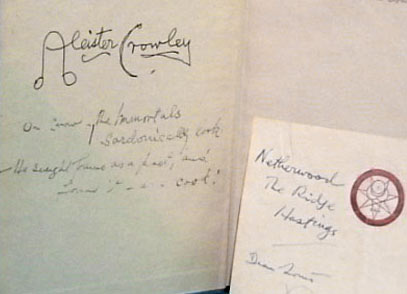
As interesting as the history of this place is, all eyes are on a thick burgundy book resting on the table, the pages a sickly yellow.  This is what we've come here to leaf through; Gerald Yorke's collection of Aleister Crowley's papers; consisting of hundreds of pieces of Crowley esoterica: iconic photos, architectural sketches, letterheads, wax seals, detailed correspondence, paintings and his business cards.  This is the flotsam and jetsam of a life, a gallery of potent direct physical connections to the past.

There's a fetishistic thrill in interacting with original documents, a sensuous enjoyment in running your fingers across the slight indentations the Crowley's pen carved into the paper, or feeling soft pencil scribbles making up diagrams, feeling as though a sneeze might blow it all away. Just the knowledge that this actual piece of paper was in Crowley's hands creates a frisson of electricity.  Turning the pages of this collection is an archaeological dig: encompassing not only the expected evidence of scandal, mysticism and kinky sex but a peek behind the curtain at mundanity - half-baked ideas and sweetly amateurish sketches.

Crowley in the robes of the Golden Dawn
There's a quaint 'Hammer Horror' feel to these sketches and photographs; a sense of a very English magic - serious looking ex-public schoolboys parading around in extravagant robes in rather mundane looking surroundings.   Leafing through these documents you begin to piece together a careful system of occult bureaucracy - application letters from prospective members, neatly typed letterheads, business cards and polite, reserved correspondence between members, entirely ordinary except for the fact that they're talking about the oncoming Æon of Horus, humanity's time of self-actualisation and the triumph of individuality and 'True Will'.

The members of these societies are often famous in their own right, a tangled web winding its way through the upper crust of London's artistic community.  Deciphering these complex relationships and various societies is tricky, but fortunately we had Gary Lachman in attendance; an expert on mysticism and the occult (and founding member and bassist in Blondie!).  He puts flesh on the bones these document's bones, guiding us through the winding labyrinth of Crowley's complicated life.

Gary Lachman talking the talk.
This was invaluable in understanding these documents.  For example, we came to a birth/death certificate for Crowley's young daughter Lilith.  In isolation this is a faintly sad, clinical document, but just a cold collection of facts.  Gary tells us a story: Crowley and his then-wife Rose were on a visit to India.  When they were due to leave (after Crowley had shot a guy), he convinced his wife that they should travel separately and that she should take his daughter with her.  His reason for travelling alone was that we wanted to sleep with a fellow occultist.  On returning to Britain he discovered that his child had died of typhoid on the journey.  Griefstricken, he blamed his wife for the death, accusing her of being too drunk to sanitise the baby's bottle. Gary archly points out that the notion that Crowley could have accompanied them doesn't appear to have crossed his mind.

These recognisably human reactions define the man as much as this collection of documents. The pictures are enlivened by tales tales of how Crowley and his friends used to hold wild parties at night in the Horniman Museum during which they'd remove the mummies from their sarcophagi and attempt to raise them from the dead. Or explaining that a reference in a letter to a mysterious Black Temple refers to 67 Chancery Lane - somewhere Crowley holed up, again trying to resurrect the dead.


Some of this stuff is bizarre even for this collection.  My favourite bit of oddness was the carefully conceived 'Crowley Grill', consisting of devilled kidneys, Cambridgeshire sausages, kidneys, anchovies, eggs, truffles, caviar on toast and devils on horseback (prunes wrapped in bacon).  He also came up with a lawn game based on his religion; 'Thelema Ball' and a board game.  These things shine a light on Crowley as shameless self-publicist, the kind of man that takes a quiet glee in faking his own death and reappearing dramatically a few months later, a man who obviously adored his status as "The Wickedest Man in the World" .

The visit dispelled my image of Aleister Crowley as a sinister man of mystery. Though it more than supports his deserved reputation as a fascinatingly radical libertine, it also shows him up as a shameless self-publicist with a juvenile sense of humour (check out his signature).  Gary's useful filling in of the blanks also paints a picture of frankly, a bit of an arsehole, Crowley attracting women on the verge of mental illness, using them in intense rituals and pushing them over the edge into asylums.  But arsehole he may have been, at least he was an interesting arsehole.

I'm pretty sure Crowley was never in touch with any mystical entities.  But that doesn't really matter.  Convincingly behave like you're in possession of diabolical powers and secret occult knowledge for long enough and people will begin to treat you as if you do - by that point you may as well actually have magical powers.  Crowley created his own personal mythology and lived it so vigorously that fiction and fact became blurred together - a process these documents chronicle in minute detail.   Though they humanise him the collection underlines Crowley's uniqueness - a life lived without compromise, full of controversy, kinky sex, dirty humour and a above all, a rapacious thirst for knowledge.

Thanks to the Curious Congress for arranging this, the Warburg Institute for hosting and to Gary Lachman for the much needed context.