Divergent (2014) directed by Neil Burger

4:03 AM Posted by londoncitynights , , , , No comments

What if the Sorting Hat from Harry Potter took over the world?  This is essentially the unlikely premise of the plodding charm-free Divergent.  Set after some undefined calamity it's been decided by someone that the best way for humanity to get by is to separate everyone into individual 'factions' - the idea being that if everyone just stays in their place things will be a lot more chilled out.

In practice this means dystopian future Hogwarts; you've got the brave protectors Dauntless (Gryffindor); the amoral intellectuals Erudite (Slytherin), and two loser factions that don't figure into the plot ('yer Ravenclaws and Hufflepuffs).  There's also the Abnegation factor, who wear all grey and eschew vanity, they're so boring and wimpy that they've been put in charge as they have no lust for power.  Anyone that's not in a faction is considered factionless, a group who seem to spend their day in rags staring at burning bins. Got all that?

Thrown into that mix are the Divergents.  They're the anomalies that don't fit into any of the factions, their very existence a threat to the whole faction system meaning they must be wiped out.  To be honest I don't really understand why they go to the trouble of even telling people they are Divergent - every one we meet seems pretty happy to join one of the factions and keep quiet so why make a big deal about it?  

Anyway, our heroine Tris (Shailene Woodley) is one of these Divergents, making the transfer from the boring loser faction to the exciting one that jumps off trains and gets tattoos.  The rest of the film is a coming of age story as we watch her inner strength and confidence grow - less signified by Woodley's performance than by the amount of volume in her hairdo. As she starts it's flat and lifeless, but by the time she's running around in an ill-fitting jumpsuit and getting into lame fight scenes she looks like she's just walked out of the salon.  You're probably wondering now whether the bastards of Erudite are planning to take over the faction system?  Whether the vim and pluck of one brave, individualistic girl can shake the very foundations of an overbearing system? And whether this girl get mad rutty with her totes hot teacher along the way?


I bet it costs a fortune to make something this ugly looking.
Yeah she does. Obviously. But the film takes a stupendously dull two hours and twenty minutes to get there. Quickly summarised, Divergent's flaws are that it's stupid, boring and cheap.  Perhaps I should give the film a smidge of slack considering that it's so obviously marketed towards a teenage audience. I'm sure they can sympathise all too well with  a character struggling to define their individuality against a system designed to shunt them into pre-decided roles.  The film is essentially an allegory for educational philosophies designed to grind out admin bods, secretaries and manual labourers - a dull future that teenagers quite rightly anticipate with horror.  But this film is so sludgy and samey - obviously produced with an eye on a wodge of that sweet Hunger Games dough - that any support of individuality is laughable.

It's just that this is just so damn boring, a kind of watery pea soup for the eyes and ears. The production design remind me of the kind of thing you'd see clagging up the schedules of the Sci-Fi channel at 10pm on a Tuesday night.  It's all shot with a tranquillised-to-the-point of-unconsciousness directorial style, making the film plods on and on without any urgency, lolloping from one overlong scene to the next.  After what felt like an eternity of people in badly fitting jumpsuits wandering badly lit corridors I checked my watch to see how much more of this I had to endure.  I figured I had to be 90 minutes into it at minimum - not even an hour had gone by.  I felt like a man dying of thirst in a desert, cresting a dune only to see infinite sun blasted sands stretching off to the horizon.  

Not even the eventual commencement of action can ease this cinematic rigor mortis. Woodley (who emerges largely blameless, obviously doing her best with a dog of a script) is completely unconvincing in all the fight scenes.  Perhaps it's the impact-free choreography or the subdued sound design, but the effect is that you're watching the rehearsals rather than the finished product.  Worse are the gun-fighting action scenes.  The guns make a pathetic muted *phut phut* sound and the impacts are so antiseptic it's difficult to tell who's being shot (to the point where the characters usually just say "he's been shot!").  I'm not a gorehound, I don't need big bloody squibs spraying across the screen - but the lack of consequences drains all tension.


Notice that the default expression in these pictures is faintly exasperated boredom. 
The most illustrative part for me was a scene where our characters stand on top of the bg electric fence separating the outside world from their city.  Our heroine asks what's out there and is told there's monsters and chaos just over the horizon.  Briefly my attention perked up "Monsters and chaos?!  That sounds fun!"  Then they shrug their shoulders, turn around and get back to being boring.  They may as well have beckoned to the horizon and said "oh, there's a more interesting film going on over there, but hey, back to the dreary task at hand".

Maybe the book this is based on is better, but Divergent is a catastrophically dull piece of cinema that doesn't even have the decency to be quick about it. If it was trimmed down to 90 minutes (which could easily be done by cutting the largely plot-free training sequences) then it'd still be a crappy film, but at least it would be a brief crappy film.  At nearly two and half hours it's the cinematic equivalent of chewing through a doormat.  I suffered through it so you didn't have to - stay well away.

★


Captain America: The Winter Soldier is in cinemas from April 4th.

'Noah' (2014) directed by Darren Aronofsky


Noah is completely bonkers in the best possible way.  The Biblical epic has fallen out of fashion in mainstream cinema and, buoyed by a love of The Ten Commandments and Ben Hur, Aronofsky is determined to bring it back with style. He does with an incredibly earnest, largely humourless, crazily imaginative and idiosyncratic ecological fable by way of some of the most symbolic and densely written portions of The Bible.

Everyone knows the basics of Noah.  God, like someone wrestling with a malfunctioning iPhone, has thrown his hands up frustration at the immoral shit infesting his creation and decided to 'Reset to Factory Settings'.  He's basically sticking a paperclip in the back of the Earth and trying a hard reset - starting again from scratch.  Well nearly from scratch anyway. He instructs Noah to build a big boat and load up two of every animal on it, the idea being that they'll survive the flood while everyone else dies horribly and when the waters recede he can have another stab at creation. I guess everyone, even God, gets at least one do-over.

What you might not remember from Sunday School are the gigantic murderous rock monsters, the post-apocalyptic industrial civilisations, the guns, steel and welding masks, the generous lashings of incest and Noah going totally nutso and setting his murderous sights on newborn babies. But hey, The Bible is a crazy book full of chatty snakes, donkeys and bushes so the odd rock giant and baby-stabbing really shouldn't be so surprising. Aronofsky clearly finds a perverse freedom to make a crazy film by sticking as close to the text as possible - it's hard to think of a better defence than to refer directly to the text themselves when making a Bible film.


The end product is a defiantly individualistic film with few obvious antecedents.  There's elements of Lord of the Rings in the grubbily plausible fantasy world, the wrecked industrial landscape recalls the Fallout series of games, the gangs of grubby raiders are lifted from Mad Max, and the way the giants move and fight are peculiarly reminiscent of Michael Bay's Transformers.  Being tossed into this world is a dislocating experience that Aronofsky exploits to the fullest, placing himself in the position of introducing us to an exciting 'new' fictional landscape within one of the most familiar stories of our civilisation.

The weight of myth lies heavy in Noah, blanketing every single decision and action in the film with incredible significance.  This intangible element is largely why the film works, arising from a combination of committed performances, excellent production design and weighty cinematography.  To various degrees of success the cast throw themselves headlong into the material, and though the younger members of the cast like Emma Watson and Logan Lerman occasionally come a bit unstuck they at least put in the right amount of effort.  But Noah is ultimately a film about grizzled old badasses, the performances from Ray Winstone, Anthony Hopkins and Russell Crowe redefining roaring, confident machismo.

Winstone, playing Tubal-Cain, King of men and direct descendant of Cain, hurls himself into the role with barnstorming gusto. Who wouldn't when you get to stand in front of an army and give a rousing speech vowing vengeance against God? Later on, when he's charging at fallen angels, spear in hand and roaring a throaty cry of rage it's difficult not to have a sneaking admiration for the guy, even though he's obviously the villain. Hopkins as the 969 year old Methuseleh is a little more restrained, interpreting the role as a playful Yoda type, shot through with the steel of countless past battles.  

But it's Crowe that utterly dominates Noah.  He's so burly, so bearded and so macho that him being able to build a boat to contain all the world's animals begins to seem oddly plausible. Impressively Crowe takes Noah from idealised, kindly all-father right through to homicidal maniac without ever losing the character's thread. He excels in subtly externalising the internal agony of the character, typified by a great shot of him sitting alone in his ark listening to the terrified screams of the hundreds outside being dashed to death on rocks by a vengeful God.  Later, when he reaches the coldly logical decision that all humans must die, he portrays a man out to stab some babies to death and still basically keeps the audience's sympathy.  There's not a huge amount of actors that can pull that off, even fewer with his astonishing level of physical commitment.

What does all this inspiration, artistry and effort add up to then?  In Aronofsky's hands, Noah becomes an ecological parable: a debate between misanthropy and philanthropy.  The Antediluvian industrial world of Noah is polluted and violent, threatened by rising sea levels that are the direct result of man's nature.  Sound familiar?  The meat of the movie is a battle between the idea that humanity is irrevocably destructive; even with the best intentions we destroy our environment and the world would be better off without us in it, and the opposing idea that humans are intrinsically worthwhile as a way for the universe to understand itself and add context to the chaos of nature.  


At stake is the beauty of the natural world, the 'innocent' animals the true victims of our unquenchable hunger.  Given the broad strokes of the fable it's not exactly surprising that Noah comes out in favour of animal rights, deliberating placing the worth of animals above even human life.  Refreshingly it even comes right out and says that eating meat is morally wrong - a position that I happen to agree with - though one I've never ever seen a mainstream movie espouse so plainly.

The film shares this spiritual/humanist intelligence with Aronofsky's earlier The Fountain.  I met Aronofsky after I saw Noah and asked him about this connection. He informed me that the two films comprise a loose duo - both dealing with the consequences of Eden - one with the Tree of Knowledge and one with the Tree of Life.  In addition the seed pod that's so significant in The Fountain reappears in Noah as the trigger to begin construction of the Ark. After their respective apocalypses both films conclude with the seeds of a brighter future being sown in the soil.  It'd be all too easy for both films to conclude that life is pointless and that humanity is a cancer on this planet, yet even after all the misery and pain Aronofsky proves an optimist, his films finding worth and purpose in the teeming, smelly, vicious mess of mankind.

Noah is far from perfect. Often it's frankly a bit of a mess, but a beautiful, intelligent mess packed with astounding visual imagery (that Creation sequence - woah!) and yet another awe-inspiring score by Clint Mansell and the Kronos Quartet.  It's nice to know that there's people willing to splash out tens of millions of dollars to realise Aronofsky's idiosyncratic vision.  The result is a fascinating piece of cinema that defiantly stands apart from the crowd and resists easy classification.

★★★★ 

Noah is on general release from April 4th

'Calvary' (2014) directed by John Michael McDonagh

9:26 AM Posted by londoncitynights , , , , No comments

Two Irish Catholic priests live together in an isolated Irish village. One of them has a cosmopolitan attitude to life that's at odds with the rural environment he finds himself in, the other is dull as ditchwater.  Their parish is almost entirely populated by the eccentric, the psychotic and the just plain weird. Sound familiar?  Yup, Calvary is a down-at-hell, darkly comedic psychodrama by way of Father Ted.  It's also quietly brilliant and very, very complex.

Brendan Gleeson plays Father James Lavelle (who is presumably not named after the DJ). He's everything you hope a priest would be: intelligent, tolerant, kind and caring, looking after his parishioners in a quietly paternal fashion: bringing a parcel of food to an elderly writer one moment, gently enquiring as to why someone's wife has a black eye the next and dispensing pretty damn good advice to confused young men. The real problem in the film the congregation; the village seems to attract sinners like honey attracts flies.

Calvary announces its intentions from the unforgettable opening line of the movie: "I was seven years old when I tasted semen for the first time".  This comes from a mystery man talking through a confessional screen, who proceeds to explain that he's a victim of Catholic child abuse and consequently he's going to kill Father Lavelle a week next Sunday.  There's never the remotest question that Lavelle abused any children - he's been chosen precisely because he's innocent, the justification being that killing a bad priest is pointless, but killing a 'good' one will send a message.  Lavelle takes the threat phlegmatically, and the rest of the film gradually counts down the days of the week until Sunday and his impending murder. The 'Calvary' of the title, named for the site in Jerusalem where Jesus was crucified, is the village beach where our priest will undergo his own sacrifice and torture.


The cinematography is austere and precise without ever seeming mannered, the jaw-dropping enormousness of the Irish geography framed to diminish the people within it. There's something primordially biblical about the landscape, the winds and waters whipping through it creating an impression of unfinished creation.  Characters lean against millennia old granite builders, or stare blankly out over a rough sea - all under an overcast sky.

The sum of all these impressions is that this is a village abandoned by God. Nobody seems remotely devout here, regarding the priest as at best a figure of fun and at worst a nannying bignose. Even Father Lavelle himself never seems particularly religious, placing his social duties to his parish far beyond any obligations he has to supernatural deities.  This absence of spirituality leaves a psychic hole in the village, something intangible has vanished from the place - while their backs were turned the devil got in.

Don't think that Calvary is a studiously Christian movie though - the Catholicism that the film revolves around is portrayed as a stuffy, corrupt bureaucracy manned by the incompetent and the stupid.  When the villagers sling jibes about the greed of the church, the out-datedness of its beliefs or its propensity for child rape they hurt Father Lavelle all the more because they're dead on the mark.


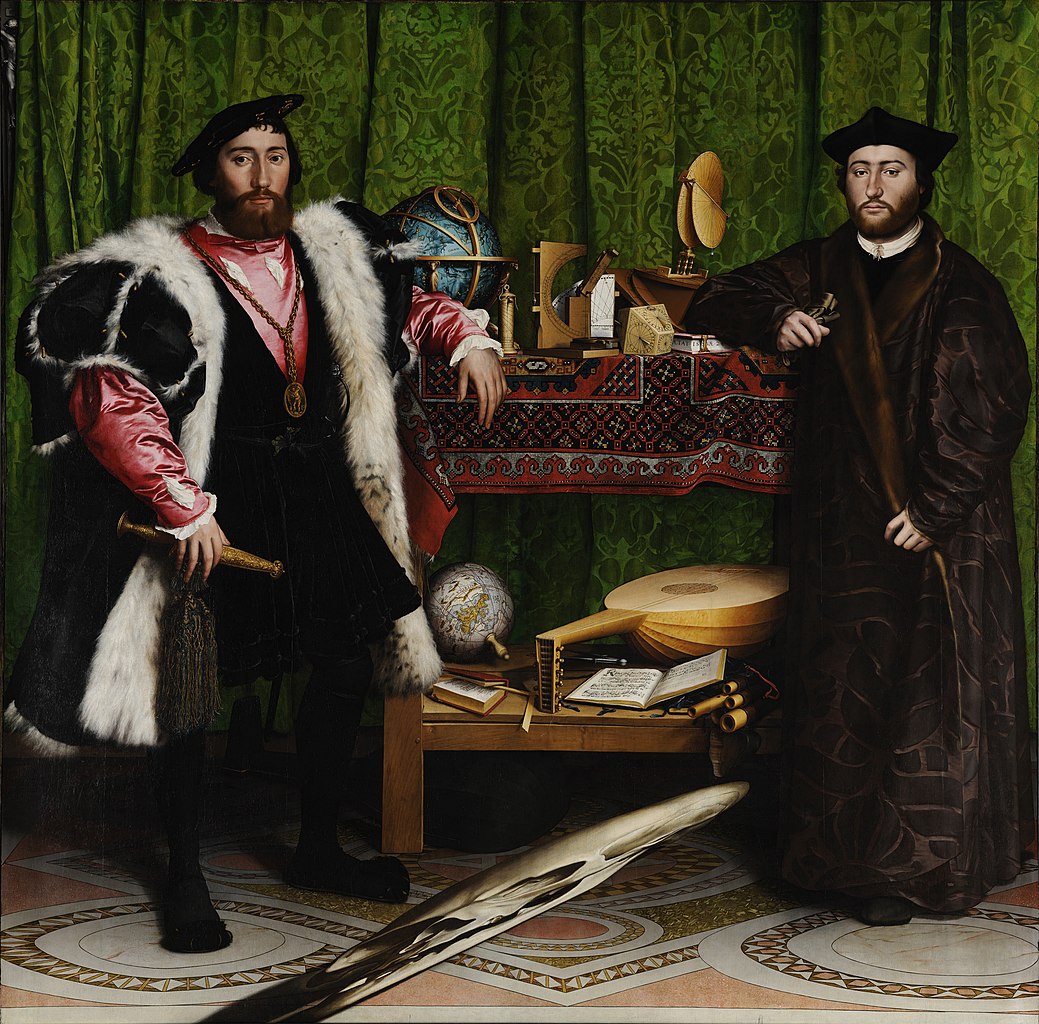
Pretty soon you realise that McDonagh intends this village and its inhabitants as a microcosm of modern Ireland. The collapse of the 'Celtic Tiger' is at the forefront of nearly all the character's minds, and the injustice of it is embodied in the character of Michael Fitzgerald (Dylan Moran). Fitzgerald is a prick; a former banker who thrived in the soup of dodgy dealings before the 2008 crash and got out at just the right time. He took his millions and ran, living alone in a fabulously opulent mansion just outside of town and sinking into a narcissistic, egomaniacal alcoholic stupor. This is a film jampacked full of pointed allegories; the angriest an astonishing moment where Fitzgerald yanks the priceless renaissance painting The Ambassadors by Holbein from his wall and pisses on it "because I can".

The slanted skull at the centre of The Ambassadors is about as good a symbol of Calvary as you can get. From the initial premise on outwards the film is obsessed with death and dying; tossing in morose stories of young children locked into paralysed, senseless bodies, young men wanting to join the army to kill people, a visit to a cannibal in prison, fatally senseless car accidents and two entirely separate suicide attempts; one happening before the film begins and one planned to happen soon after.  

If all this is an allegory for modern Ireland, John McDonagh must be a deeply pessimistic dude.  Here we see a morbid, traumatised society on the brink of collapse; spiritually vacant, sexually abused and economically assaulted this is a world spiralling down the plughole. The best intentions of good men count for nothing within this nihilistic, bleak worldview, the film essentially concluding that we're doomed and nothing (certainly not God) is going to save us. It all comes together over the closing credits, interspersed with the names of grips and gaffers are shots of the sets devoid of people. Somehow, somewhere the apocalypse quietly crept in, the disappearance of all life just about the only peaceful conclusion McDonagh can imagine.

Bloody hell that got a bit grim. I should mention that on top of all of that Calvary is pretty damn funny. Everyone gives their all, particularly Brendon Gleeson who absolutely nails the role to the extent that it's difficult to imagine any other actor hitting the same subdued, intelligent emotional notes as he does here.  The script is dynamite, the casting is top-notch and it's just sonically and visually sumptuous. A delicious treat of a film.

★★★★ 

Calvary is on general release from April 11th.

Captain America: The Winter Soldier (2014) directed by Anthony & Joe Russo


When Iron Man was released in 2008 it was a shot across the bows of the superhero genre. A combination of great dialogue, brilliant casting and slick pop-inflected direction added up to a film that, while easily recognisable as a Hollywood blockbuster, possessed something new and unique.  But six years on, with nine Marvel films and a TV show under their belt, what was once shiny and new is now slightly and predictable. Audiences know the score with Marvel movies so they have to mix things up - be it through the buddy cop comedy caper of Iron Man III or the upcoming bonkers-looking space opera Guardians of the Galaxy. So what's new for Captain America and his buddies in SHIELD?  Well Marvel has decided to get political, and boy is it a mess.

The Winter Soldier revolves around a simple question; what if the goodies were (wait for it) secretly baddies? SHIELD, who have always been depicted as US Homeland Security on steroids were treading pretty questionable moral ground in The Avengers and as The Winter Soldier opens we find them wading through even murkier waters.  They're building a fleet of enormous flying gunships capable, as a proud Nick Fury explains, of eliminating threats before they even have a chance to harm anyone.  This doesn't sit right with the upstanding Captain America, who blithely notes: "This isn't freedom. This is fear."  

This all sets the stage for a twisty-turny tale of double-crosses and betrayals interspersed with car chases, huge explosions and burly guys punching each other to no obvious effect. It's pretty clear what the Russo brothers are going for:  All the President's Men with superheroes.  They've even cast Robert Redford, who obligingly leans against windows overlooking Washington and hammily pronounces guff like "In order to build a better world, sometimes you need to tear the old one down." (During this scene a huge, blinking neon arrow is pointing at Redford reading "He's the baddie!".)  

I suspect that knowing that Captain America is a pretty boring superhero, they put in this guy, an even MORE boring superhero, to make Cap seem more interesting in comparison.
There's a whole bunch wrong here but it all boils down to simple cowardice. The film is obviously the product of a post Wikileaks/Snowden world, drawing none-too-subtle parallels between the mass surveillance of SHIELD and the evil shit the NSA has been up to.  The problem is that though the film sternly wags its finger at this sort of thing via the totemic 'golden generation' figure of Captain America, it just doesn't have the guts to be outright condemnatory. The end product is a castrated film, one that wears the trappings of a political thriller but without the politics - rendering it impossibly slight at best and dangerously simplistic at worst.

The biggest flaw is that with agencies like the NSA and GCHQ et al being genuinely supervillainous in real life there's very little room for exaggeration. So the film becomes an infantile exploration of what might happen in a mass-surveillance society if there were a few superheroes about, which feels vaguely masturbatory.  But hey, a bit of wish fulfilment isn't such a bad thing right? At the very least it should be cathartic watching a muscular man in a brightly coloured costume decking the person who ordered all this surveillance.

It's not - primarily because the crux of the film is two quasi-fascist organisations squaring off against each other. The anti-democratic Fury-knows-best tight uniforms and black ops wetwork world of SHIELD versus HYDRA, literal Nazis.  It's Nazis versus Nazis folks, and the film expects you to root for the 'good' Nazis. If this weren't merely an episode in an ongoing multi-billion dollar franchise it could have shaken things up, but it's almost obliged to return to the status quo by the time the credits roll.  Nothing can change too much in Marvel's world, so in place of actual politics the film settles for criticising the mass surveillance of citizens by painting it as an attack on the incredibly nebulous concept of 'freedom'.

Easy on the eyeliner there son.
We're in George W Bush country here folks, the extent of Captain America's political nous expressed as "The price of freedom is high... and it's a price I'm willing to pay!".  Listening to doggerel like this you want to slap the film around the head - it's rubbish like this that created the very situation you're criticising!  The conclusion it arrives at is that mass state surveillance is an alien intrusion into the fine process of US militarism and that once you've gotten rid of that problem everything will be just hunky-dory and we can go back to the 'regular' military state. So The Winter Soldier ultimately finds itself in the perverse position of arguing that we merely need the 'right' kind of fascism.

Frankly it's a bit of a mess elsewhere too. Chris Evans does the best he can, but it's difficult to get away from the fact that Captain America is a pretty dull superhero.  Things aren't helped by giving him a partner who can fly (which is ready salted crisps as far as superpowers go) and one that can shoot people.  The titular Winter Soldier is a non-character, having maybe 4 or 5 lines in the entire film, spending most of his screentime glaring petulantly like a teenage goth forced to go on holiday to Disneyworld. 

It's all a bit of a shame. If this film had a bit more bravery and brains it could have been a great piece of subversive agitprop with a huge potential audience.  As it is it's just a dumb blockbuster with pretensions of relevance working studiously through the established Marvel movie formula. A formula that's looking increasingly creaky as the countless sequels tick by.

★

Captain America: The Winter Soldier is on general release.

'Muppets Most Wanted' (2014) directed by James Bobin

3:28 PM Posted by londoncitynights , , , , , , No comments

Pixar spent years wrestling with millions of polygons and complex shaders to get their characters to emote believably. Jim Henson did it with some felt and a ping pong. In a digital era the Muppets are fiercely analogue, somehow intrinsically nostalgic.  Admittedly I've never been a huge Muppets fan myself; I enjoy The Muppet Movie, The Muppet Christmas Carol and though I never technically saw the 2011 revival, I did watch half an hour of the French dub while drifting in out of consciousness in a Dutch flophouse and from what I can remember it looked pretty fun. Even so, something about these characters never quite did it for me.  But after watching Muppet Most Wanted I think I'm finally coming around.

This is an old-fashioned caper comedy with a great gag every few seconds that just about manages to sustain a snappy momentum until the credits finish. The plot revolves around the machinations of Constantine, "most dangerous frog in the world". Escaping a Russian gulag he sets out to steal the British Crown Jewels with the help of his number 2, the mysterious 'Lemur'. Meanwhile the Muppets have just taken on slick new manager, Dominic Badguy (Ricky Gervais).  Soon Constantine and Kermit have switched places; the slimily violent criminal in charge of the Muppets and our loveable frog hero thrown into a dingy gulag hellhole populated by the likes of Ray Liotta and Danny Trejo and run by Nadya (Tina Fey), an icy Russian dominatrix type. 

Naturally none of this guff is taken at all seriously, the plot functioning as a vehicle for a series of brilliantly written songs, top jokes and decent enough action sequences. There's a Simpsons-esque devotion to ramming as many jokes in as the film can take without collapsing under its own weight. The jokes range from simple (but well-executed) slapstick to cutaway parodies of Ingmar Bergman, or split second appearances from celebrities ranging from Lady Gaga to Russell Tovey.

I know Kermit's director costume is a reference to somebody.. but who?
Going in I had my misgivings - primarily Ricky Gervais-based. Though I enjoy The Office I find pretty much everything he's done since annoyingly ingratiating. There's only so much infuriatingly smug "isn't this silly" mugging to the camera I can take. That all said I've got to admit that Gervais is damn good here, fitting snugly into the Muppets universe and, by and large, taking his character as seriously as he needs to.  In musical terms the showstopper is the excellent I'm Number One, a duet between Gervais and the evil Constantine, a beautifully constructed piece of musical cinema between man and muppet.

Similarly excellent is Tina Fey as the buttoned up Russian prison guard with a secret soft spot for Kermit. Though stern, domineering and faintly scary she's somehow loveable, managing to make her admiraiton and growing infatuation for a felt frog puppet weirdly believable.  Also (and I hesitate to mention this), Fey looks totally bombin' in the vaguely Soviet uniform she wears, the outfit pushing hidden buttons hitherto unknown in my psychology.

But good though the human characters are, this is very much the Muppet's movie. Kermit, Miss Piggy, Gonzo and the rest all getting their individual moments in the spotlight - and it's their emotional development that anchors the film.  It's a testament to the skills of Jim Henson that it's so easily to get wrapped up in his idiosyncratic universe, instinctively buying into the love between a pig and a frog and really, genuinely caring about these Muppets staying together.

Damn that uniform is fine.
While the classic Muppets are all well-served, the villainous newcomer Constantine is a highlight. I think he's simply a Kermit puppet with a mole on one cheek, but whoever's got his hand stuck up his arse does a great job of making him physically distinctive from Kermit. Constantine scowls, curls his lip in disgust and generally evils it up throughout the film - all conveyed through a slightly different way the puppeteer moves his hand. He's deftly, quickly and humorously drawn - simultaneously laughable, an obvious threat and makes the idea of "the most dangerous frog in the world" strangely plausible.

And now onto the geopolitics of the film.  Obviously.  During the gulag scenes (which take up a sizeable portion of the film) it's easy to let your mind wander to the letters written by Nadezhda Tolokonnikova of Pussy Riot about her experiences inside a Siberian prison camp.  While these scenes are lighthearted there's a kernel of accuracy to them, and though there's (probably) less impromptu dance numbers and comedy slapstick inside a real gulag, the casual sadism that Kermit endures probably isn't a million miles from reality.

Kermit & co in the gulag.
These sequences are intercut with images of London, the glittering buildings of the City carefully framed in the background of shots.  Bobin dissolves from one to the other in such a mannered way, that, as loopy as this sounds, I began to suspect he was drawing a pointed connection between the opulence of London and the human rights abuses of modern Russia. After all, it's the City that launders Putin's crony's money - even seeking exemption from current economic sanctions.  The main plot is Russian criminals seeking to seize the symbolic heart of the British nation! Am I reading too much into this?  Is Muppets Most Wanted really an subtle indictment of Putin's Russia?  Ordinarily I'd think not, but then I remember the last Muppets movie was pilloried in the right-wing media for criticising the oil industry and I wonder...

Vladimir Putin aside, Muppets Most Wanted is really really good (whether you buy the geopolitical allegory or not).  You can't really go wrong with this one. Great gags, great songs, great Muppets.  

★★★★ 

Muppets Most Wanted is on general release from 28 March

FEMME:SKIN at the Stratford Circus, 20th March 2014


Forget Bunker Hill, Waterloo and Hastings: the important battles these days take place in the amorphous land of ideology. This is a war between old gods and the modern world and one of the fiercest fights is for the female body. As the traditional battleground is cratered, scarred and deformed by the treads of tanks and the boom of mortar fire, so 'woman' is pressured to be pumped full of silicon, shrunken into emaciated waifdom or simply denied reproductive autonomy.  This is a war of ideas, both sides enviously eyeing each other's territory and engaged in myriad skirmishes.

FEMME:SKIN, a new exhibition in Stratford curated by Beth Watton, aims to chart some of the contours this war.  In the public area of the Stratford Circus she's assembled an array of artists working within multiple disciplines, all of whom with something to say about "the female body as a political and performative site".  The Stratford Circus is a pretty interesting place for an exhibition - the gallery area acting as a thoroughfare and all purpose cafe rather than being particularly devoted to art. 


Placard from Armpits4August
Down on the ground floor there's space devoted to the Armpits4August campaigning group - who advocate women going unshaven over August. There's a neat can-do arts and crafts roughness to what's displayed - home-made placards read "VENUS WITH FUR" and "HAIRY FEMINIST" - all bearing creases and scuffs from being waved at various demos. Interestingly, rather than being framed or behind glass, they're bulldog clipped to the wall. One of my pet peeves is the fetishisation of protest art - taking something scruffy and vibrant and preserving it in aspic. But this material is still very much alive, ready to be plucked from the wall and used as a tool for change rather than something to merely be gawped at.


Paige Bradley - Americana
Up a floor we see the work of Paige Bradley, a multidisciplinary artist from California.  Her sketches somehow show the body without the body present, soft pencil lines suggesting a ghostly geometric motion. It's as if the imperfect body has evaporated away, leaving only the purity of action and consequences. The same can't be said for her impressively fleshy Americana. In glowing earth tones a woman lies in a loose cruciform, trapped within red, white and blue blocks.  There's a satisfying tactility, the contours of her body shaded in yellows, oranges and light pinks giving the impression that she's the source of light within the scene.  Though the natural reading is to see it as a figure lying on her back the abstract backdrop gives a dislocating gravity, a woman floating in an expanse of patriotic fervour; a pout of boredom on her lips, an insouciant flicker in her eyes.


Following the walls around you're lead through a panoply of different ideas and interpretations of the female mind and body, both in abstract and physical terms.  One of my favourite pieces is above (which I've just learned is by Phil Fisk and not actually a part of FEMME:SKIN whoops). A  woman in a cleaning tabard arches her back in ecstasy, howling through a mist of cleaning fluid. Low-paid, low-status workers like these fade into invisibility - they're in our offices and shops before we even lift our sleepy heads from the pillow. They clean up our shit and vanish - the only evidence they were ever there a faint smell of sweet citrus.  This work places them in the spotlight, showing a dance that knots together elements of ritual, pole-dancing and ballet into a one action that underlines the power of femininity even within conformity, routine and minimum wage drudgery.

But of all these pieces, my favourite thing in the exhibition is Irina Shengelia's Little Remains.  Here we see brunette hair extensions, pigtails and ponytails emerging from within pictureframes, partnered with a virginally white slip that resembles a baptismal dress and white roses.  The title here, Little Remains has a dual meanings, abandoned objects of childhood and unnatural tragic death - remains in the bodily sense of the word.


Irina Shengelia - Little Remains
The British tabloid media is at its worst when it gets a sniff of the murder of a young girl. The front pages whip up a whirlwind of sensational eroticisation, pruriently obsessing over on the innocence and virginity of the dead girl: reducing her from person to a collection of cliches and idealised stereotypes. The most obvious example is Madeleine McCann, immortalised as the absent idea of 'Our Maddie', the reality of the missing person irrelevant under a teetering pile of cliches, wishful thinking, projections and complicated ideas of what a child really means to us. In symbolic terms she, and other missing girls, have been transmuted from person to idea. For me this work is a representation of this process in action, the depersonalised that make up the stereotypical 'girl' frozen in time like pinned butterflies behind glass - the reality of the person underneath all this forever absent.

It's great to see exhibitions like this taking place in public spaces. All too often work of this kind is relegated to the walls of galleries, viewed only by an elite few and appreciated by an even smaller subsection of them.  Here, with a steady trickle of people in and out of the space they'll have room to breathe and be noticed. There's much more here than I've described too. Check it out!

FEMME:SKIN is at the Stratford Circus, E15 1BX until 23rd April 2014.

'Back to the Garden' (2013) directed by Jon Sanders

8:21 AM Posted by londoncitynights , , , , , , No comments

Back to the Garden is a serious test of cinematic patience with scant reward at the end.  This micro-budget drama is so austere and so deliberately paced that Sanders seems to be daring his audience to keep paying attention.  A film being boring isn't necessarily a death knell for its quality, on a masochistic level I enjoy films like Jeanne Dielman, Satantango or Wavelength - films where for long periods nothing much happens.  Back to the Garden comes from a similar kind of place; slamming on the brakes and forcing you through excruciatingly dialogue scenes.

The plot is essentially an English The Big Chill doped up on valium.  A man has unexpectedly died and his friends gather in a secluded house to scatter his ashes in the garden.  The group is white, middle-class and obviously reasonably financially secure; yet each is experiencing their own subtle depressions, the death of their friend dredging up dormant fears of mortality and what they're doing in life.

What this entails is long still shot after long still shot of two characters talking in a rather normal garden.  The end credits inform us that the dialogue is improvised, so conversations meander and drift, often dancing around what they really want to say for minutes on end before whoever's speaking confesses what's on their mind.  This makes up perhaps 90% of the film; so if faintly miserable middle-aged people mumbling in gardens is what cinematically turns you on you're going to be in hog's heaven.

As for me, much of this film was about as interesting as paint drying. Even taking into account the miniscule budget, visually this really isn't up to much. There's the odd artfully composed shot, yet they're spoiled by digital photography that suffers from very noticeable interlacing problems: meaning straight lines suffer from 'jaggy' edges.  This makes the film look far cheaper than it should, often resembling the cheap and nasty look of 90s television.  (Although if this interlacing was merely a problem on the version screened please comment and tell me.)


I could overlook all that if the film was a powerhouse showcase of acting talent, but it's not. For the most part these performances are competently alright but there's nothing here that's going to set the world on fire.  These rather thankless roles require the actors to behave like they've been shot with tranquilliser darts, slowly moping their way from long shot to long shot in an Eeyorish daze.  There are brief moments where glimmers of passion poke through the surface of this stagnant pond - moments you grab onto like a drowning man clutching a life ring - but they're fleeting and quickly pass.

That said, there is one notable highlight among this troupe; Bob Goody's Jack.  In a film with Death hovering just above proceedings the cast have mostly become corpselike in response. It's only Goody as Jack who provides anything close to a compelling character, enjoyably bumbling his way through a doomed, unrequited love affair and pondering over whether there's any point continuing his marriage.  Of the the cast it's Goody that seems most at ease with the improvisatory style of the film, able to naturally digress a bit in a pretty seamless way.

Another one for the 'positives' column is the nice score by Douglas Finch.  The film actually begins pretty promisingly, with some Terrence Malicky shots of stars, rivers and spiderwebs all underscored by a beautiful piano led score.  Throughout the film there's the odd musical interlude between scenes; these short bursts of music doing a far clearer job of conveying mood and tone than the muddled dialogue ever does.  Though I was eagerly awaiting the credits to roll so I could find something more interesting to do, I stuck around for them purely because some twinkling stars and Finch's score was much more compelling than nearly all of the film that preceded it.

What's perhaps most frustrating is that in the middle of the final sequence the film briefly does something actually interesting.  Up to the end of the film there's been no obvious reason why the film wouldn't work as a 'Play of the Day' on Radio 4, yet for one brief moment there's a subtle bending of space and time that is easily the best bit of the film.  Even more impressively this goes by completely unremarked, Sanders trusting that his audience is paying sufficient attention to pick up on it.

Despite these few slivers of positivity this film, quite simply, is boring. Even with a mercifully short 90 minute run time it drags on and on, exploring the inner-world of characters we're given no reason to care about.  Stylistically Sanders approaches Dogme 95 levels of filmic austerity; the improvised dialogue, dodgy technical aspects and really low-key story leading me to suspect that Sanders is attempting to capture some kind of 'reality' on screen, a filmic world shorn of mainstream narrative pretensions. On that front I suppose he's succeeded because Back to the Garden absolutely captures what it's like to be trapped at a crap party with a load of miserable people.  

★★